

The violinist glares out through his window at a cacophonous mob who have seemingly invaded the street outside his house; theatrically he attempts to block out the appalling noise by placing his hands over his ears, still grasping in one hand the violin bow with which he was presumably trying to practise before being so rudely disturbed. Yet on the wall of his house we see a poster advertising a performance of the “BEGGARS OPERA”. The irony could not be clearer.
So why do I sense an all too similar stench of hypocrisy – almost three hundred years later – in the torrent of criticism levelled at buskers in Leicester Square by a consortium of music radio stations with offices adjoining the square, who have sued Westminster Council (the relevant local authority) for not sufficiently controlling the noise of these street buskers. ‘Their staff complained of being “plagued“ by poor-quality musicians and said they had to wear headphones, and work from cupboards to escape the sound’ (Evening Standard).
Do I perhaps have a vision of representatives of these same radio stations attending music business jamborees where the supposed “street credibility” of the favoured artists will be celebrated? And maybe I further suspect that the radio stations themselves will still be broadcasting saturation levels of the limited repertoire of songs (typically forty or thereabouts in any given week, if memory serves) that make up their blanket playlist for the week. Repetitive indeed.
Furthermore, who could have foreseen how draconian would be the judge’s reaction to, or indeed how timid (one can only suppose) must have been Westminster Council’s defence of, the accusations made by Global Music in pursuit of their aims? “Repetitive sounds are ‘a well-publicised feature of unlawful but effective psychological torture techniques'”, so pronounced Judge Law in his damning summing up, where he supported Global Music and ordered Westminster Council to put an end to the nuisance.
And does it not seem a strange kind of justice, where there is collective vilification of a group of musicians who were given no chance to answer for themselves?…and where no evidence is presented, or even referred to, of any dissatisfaction with the musicians amongst the public who flock to the Square, listen to the buskers, and patronise the various entertainment establishments there? The term scapegoat comes to mind.
But then why do I worry? My busking days are over. It has been many years since I and my colleague Bongo Mike fled to the continent, to avoid daily interruptions to our performances in the West End (and weekly appearances at Bow Street Magistrates Court); and many years since we returned to these shores – determined to fight our ground – and through our court cases and their attendant publicity, brought about a climate of relaxation for a time, in public places.
If that time is over – if officials of the state now see fit to describe street music as “psychological torture” (and I do wonder how much personal experience of being subjected to real psychological torture our judge will have had) – then I can only hope there will emerge new champions for our cause, to whom the baton can be entrusted.
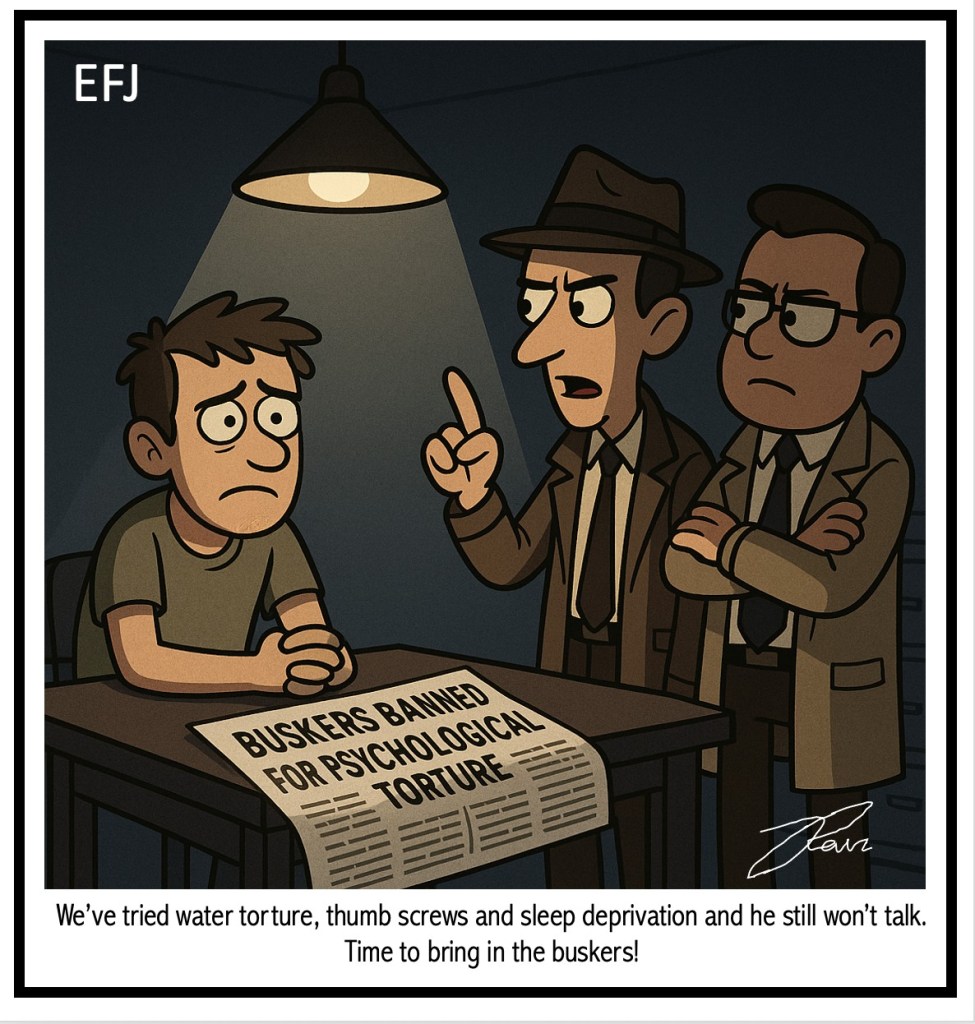
And I can only pray that those who would like to see the expansion of busking through co-operation with all manner of local authorities etc. do not get the idea into their heads that they can trade off the free-wheeling, independent nature of our art-form for sponsorship deals and the like. If I may be allowed to quote from an earlier post entitled “An Artistic Disturbance Of The Peace”:
When a busking performance is successful, one of the main features of that success is that the busker is just there. No other form of entertainment achieves this, so far as I know, and in a city such as London, a hothouse of massive plans and ambitions, both collective and individual, it is like a flower that can grow out of concrete. Licensing, and similar attempts at organization, essentially kill off this unique aspect of busking, and like some cheap three card trick substitute for it a new rôle as an underlayer of the regular music and entertainment business.
 The Story Of Situation Art