“Situation Artist?!!…. You’re a busker – get used to it.”

Well, after skirting round the issue for a considerable period of time, with many stories about what happened to Mike and me as we practised the form of art which seemed to get us into arguments and trouble the world over, I’m now going to try to explain what we meant by the term “Situation Art”, and why we were so attached to it. When I have had my say, you might still respond (as a one-man-band of our acquaintance once did) with the immortal words of our title above. But I hope not.

I shall take the argument through the following steps: a brief history of the involvement Mike and I had with the traditional culture of broadsheets and busking; a contemporary analysis that we arrived at of what we were doing, introducing the idea of Situation Art; a look at the problem of the non-recognition of Situation Art as a “self-standing” category, and the misunderstandings this causes; further definition of Situation Art, by comparison with a classical music performance and a theatrical performance; and a brief study of the meaning and value of Situation Art in today’s cultural context, along with some consideration of official attitudes to it.

But first a word of caution; the problem today is that there has been a partial acceptance, not to say adoption, of the style – everything’s “street” this and “site specific” that and “accessible” the other, and “pop-up” yet another — and you find yourself saying, wait a minute, we were doing all that way back, before there were any prizes given for it….. in the days when the best you could hope for was a free ride to the Police Station in a Black Maria!

So I’m handling today’s post with care – over the course of a lifetime a lot of things change their shape. You have to be careful that you’re not just continuing with yesterday’s battles after they’ve ceased to be relevant, and yes, sometimes you have to know when to back down. But I think it’s also good that someone keeps an eye on whether real progress is being made in relations between artists and authorities, despite the apparent blooming of interest in public place art.

STREET POETRY
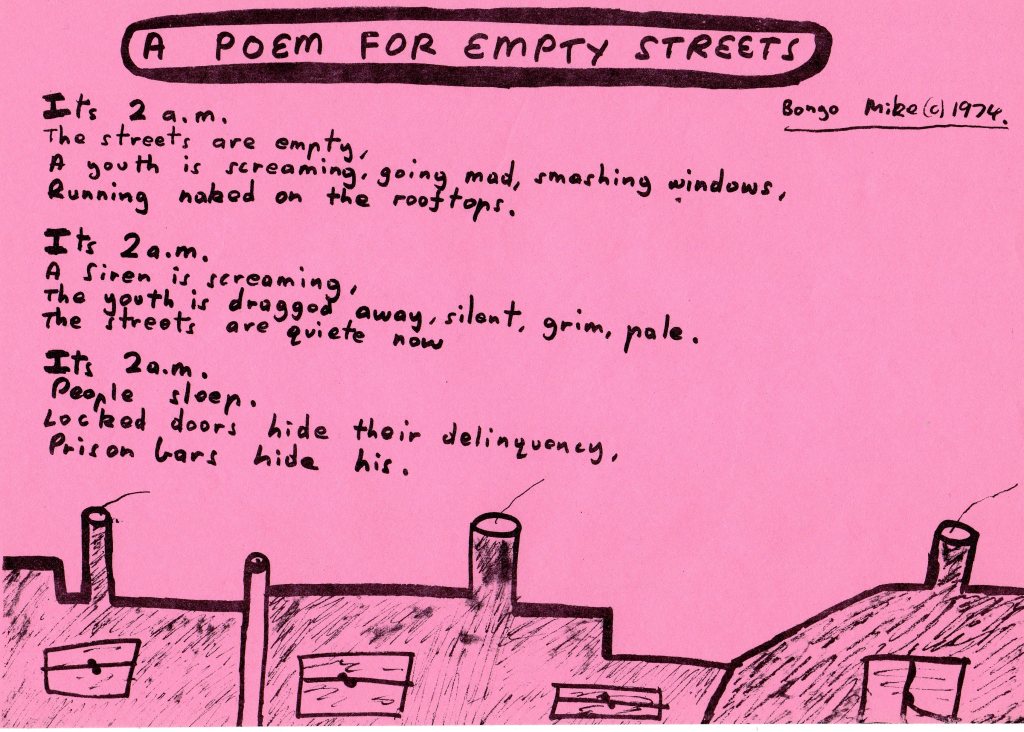
A Street Poem – one of about 70 distributed by Mike and me in London and certain other towns around England and Wales from 1972 till 1978.

Consider poetry, for example. It sometimes looks as if any poet these days who isn’t published by Faber and Faber can call themselves a street poet. But what does that actually mean, indeed does it really have a meaning at all? I’ve reproduced below an article from the London Evening Standard of May 1973, called – funnily enough – “Street Poets”, which is mainly about Bongo Mike, and which I think gives quite a reasonable account of what you might expect the life of somebody calling themselves a street poet to be like. As the journalist Angus McGill wryly comments, “the life would not have appealed to Alfred Lord Tennyson”.
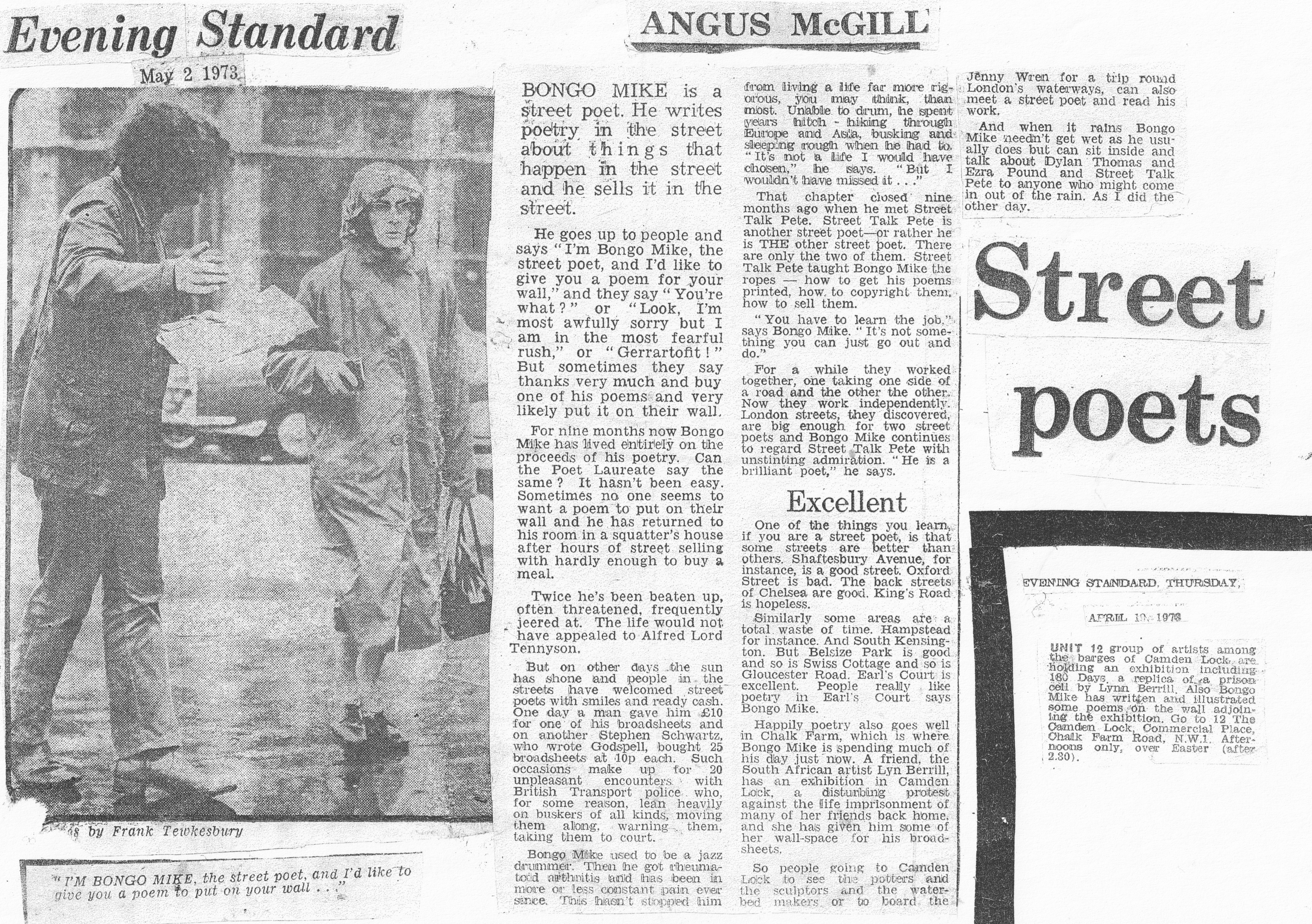
Now, there was a performance element to our street poetry (I say our, because I joined Mike out in the street, from Spring 1974 until we wound the operation down four years later) – or perhaps it could better be described as an interactive element. Anyway, if we take a close look at a few memorable lines from the celebrated poem “The Waste Land”, by T.S. Eliot:

Unreal City,

Under the brown fog of a winter dawn,

A crowd flowed over London Bridge, so many,

I had not thought death had undone so many.

Sighs, short and infrequent, were exhaled,

And each man fixed his eyes before his feet.…

(from The Waste Land, Part I. The Burial of the Dead)

we can then consider that some fifty years after this was published, street poets were entering the scenario, distributing poems (or at least attempting this feat) to those apparently undone by death.

STREET MUSIC

Towards the end of the 1970’s we decided that living solely from poetry was getting tough: inflation similar to today’s was making it difficult to set a realistic-sounding price on the sheets we were offering the public, and it was starting to seem like a misfiring idealistic venture rather than a joyous celebration. Though it must be said that in general – albeit not everywhere – we had been free from interference or harassment by police etc.

As street poets, operating frequently in London’s West End, we were of course acquainted with the characterful collection of buskers who were also around: Ronnie Ross and his Sand Dance, Don Partridge and his associate Alan Young, Scotty, Herman the German, the Earl of Mustard (otherwise known as Jumping Jack), Old Meg Allan, and Paris Nat Schaeffer (whom sadly I never met, on account of his early death, but still heard all about from Mike and others)… It was an inspiring bunch of people. And with encouragement particularly from Ronnie Ross, we set out to develop our own individual musical act, as what we hoped would become an alternative to – if not a huge step from – poetry as a mode of income.

Street music, or public place music might be a better way of putting it, happens in a large-ish variety of situations. After a couple of false starts, we found our first success in Green Park Underground Station, by the side of the passageway joining the Piccadilly Line and the Victoria Line, at Easter 1978. The song which resonated with the passers-by was one of Mike’s compositions “Kilburn Station”, a slow moody song which sounded perfect in the subway. (We’ve since recorded a version of it with a slightly expanded musical arrangement.) But from what I remember, we saw little chance of earning a living, performing in an environment replete with “No busking” signs on the walls, and where, away from Easter, many other players would be jockeying for a pitch.

Our next success was on the street outside Earls Court Underground Station in the early evening, featuring a song called “Midnight Special”. Unfortunately we didn’t last long there – after a few days the friendly local police put a stop to the party.

On the third attempt, we found a pitch we could call our own – Coventry Street, in the evening, outside what was then known as “Bernard Delfont’s London Experience”. A song we wrote there had a peculiar origin: it was a quiet night, not many people out, and we were in a creative sort of mood; I was playing a repetitive riff on the guitar, and Mike was starting to sing extracts from one or two of his poems, to the rhythm. Suddenly two police officers walked up to us and – as usual – ordered us to stop playing. We packed up and went home in disgust, but the following day one of us said “Well if that’s what they want, that’s what they can have!” – we picked up the rhythm again, but in place of the planned mellow poetic lyric, we put a court case where a musician is arrested and tried in a Magistrates Court, and found guilty of busking. (I have described the scenario, including a later electric version of the song, in an earlier post The Professor of the University of the Street.)

This, together with other edgy songs we composed or adapted while playing there (“It’s A Crime to Play Music in the Streets”, “Family of Freaks and Schizophrenics” and “I Just Wanna Live My Life” come to mind), fitted very well the context in the West End; and if it weren’t for the fact that we were spending more time in Bow Street than Coventry Street, we might have continued there for many years, instead of heading off for a nomadic life on the Continent, where we became café and terrace players, delved into Mike’s jazz heritage to develop our “Spasm Band” act – and acquired the freedom of approach to take on playing on moving trains and trams, something which we then brought back to London, on occasional visits “home”.

SITUATION ART

But in every country we went to, whether the act of performing in a public place were illegal, semi-legal or broadly tolerated, we found that street musicians were exploited and relatively down-trodden. This is not to say that we were treated uniformly badly- there were great times, and golden memories. But we were always conscious of something missing. Artistic acceptance. We had come off the pedestal of poetry, don’t forget, in our attempt to find a better way to relate to the public place audience; we had developed a populist act, built around original musical material; but we were not taken seriously, by comparison with either classical artists or pop artists.

Then one day in early 1981 we had our “lightbulb moment”, as described in the first post I published on this site, Welcome , when we saw that there was a specific artistic identity that ran through all the different types of performance we did in all the different towns we visited (including street poetry in London, as we realized at this point) – and Mike gave it the name Situation Art.

As we developed this idea of Situation Art, we realized that it represented an artistic perspective in its own right, quite separate from the conventional skills (be that musical proficiency, quality of voice, excellence of repertoire etc.) exhibited by the performer. It had to do with the relevance and appropriateness of the performance to the situation – and thereby brought the situation, with all its diverse possibilities, into the equation. And it seemed to us, that it was only by an idea of this sort being accepted, at an intellectual level, that buskers would ever be recognized as artists in their own right, and so be elevated above the degraded level at which they were generally valued in the days when we were active – e.g. as some kind of traditional “folk hero”, or maybe as a music student getting some practice while studying, rather than a particular type of performer, doing something with its own timeless validity.

Musical buskers tend to get judged by so-called experts on the basis of how good a musician the expert considers them to be. Yet some of the most memorable buskers might be hardly musicians at all, in the conventional sense. For example “Coneman” (as he was affectionately christened), who would somehow acquire a traffic cone, and by blowing through a hole in the top of the cone would turn it into a kind of wind instrument with its own distinctive sound; or Victoria the Comb Lady (see below), a Dixie-style soloist who played her comb with us a few times outside Brixton Station where she was generally to be found.

Comb, kazoo, guitar, bongos, voice in Brixton

And it is widely held to be part of the history of Jazz, that street bands in New Orleans, known as Spasm Bands, playing music of uncertain origin on homemade instruments, as the 19th century morphed into the 20th, were one of the founding pillars of the new culture. Early critics of jazz were not especially impressed, and could find quite negative things to say about it, e.g. “It is not music at all. It is merely an irritation of the nerves of hearing..” – this from a Professor Henry van Dyke of Princeton University. Of course, Jazz later became much more accepted, but as the intellectual heavyweights moved in, the Situation Art aspect of its early days was almost entirely phased out of the picture. (See Herbert Asbury, “The French Quarter” and Robert Goffin, “Jazz: from Congo to Swing”.)

That is not to say that Situation Art theory necessitates a conflict with conventionally proficient performance – of classical music, for example. But we only have to look at the experiment carried out by a famous American violinist performing incognito in a Metro station in Washington in the early morning and receiving only 32 dollars in the hat (as reported in a Washington Post article of April 2007 entitled Pearls Before Breakfast) to see that a “virtuoso performance of some of the greatest pieces of music from the western tradition” doesn’t necessarily work in every location at any old time of day.

Art which requires such a degree of worship, it seems, needs a suitable temple to be properly appreciated;but places need to be respected too; a player dressed as a clown doing a simple bit of juggling might have been more in keeping with that draughty passageway than Mr. Bell. And further, what sensible busker would choose the early morning rush-hour to try and get through to anybody? !

ALL THE WORLD’S A STAGE

In a foretaste of today’s discussion, I quoted – in an earlier post – from a book written by Peter Brook called “The Empty Space”:

“I can take an empty space and call it a bare stage. A man walks across this empty space whilst someone else is watching him, and this is all that is needed for an act of theatre to be engaged.”

I mention this because I came across it after many years of being fascinated by the experience of sitting on the westbound District Line platform on the London Underground, at Victoria or Embankment Station, watching the eastbound platform slowly fill up with passengers after being emptied by the departure of a train. Like in a conventional theatre, some actors appeared from a staircase at the back, others from what seemed like the wings, at the side; and of course some were static on the platform already, the departing train not having been theirs.

Snatches of conversation might waft across, though a little indistinct, but one could exercise some imagination.
So… a conventional playwright might be inspired by the scene depicted above, and go away and write a play about it. A situation artist would be more likely to get on the next train with them and sing a song – or indeed recite a poem. (See picture below.) More interactive, more direct… But I’m not saying that the world should have either one or the other. I’m just making a case for what I’ve spent my life doing.

And, it being a quite different kind of thing from conventional, organized artistic events in which London abounds, it requires a different skill-set…Situation Art, as I have been calling it.

BEAUTY IN PUBLIC PLACES – AN ARTISTIC DISTURBANCE OF THE PEACE

I’m turning now to an article called “Discover: A Beauty of Situation, Provisional and Lived”, which appeared in a Belgian online progressive arts magazine called Archipelago, in 2012. The writer talks about various aspects of what he calls “beauty in public places”. He considers, among other things, the work of myself and Bongo Mike, taking ideas expressed by us online over the years, and putting them in a broad art-philosophical context. The whole article is interesting, but I’m only going to quote here what is immediately relevant to my drift. (It has here been translated from the French,)

He talks about what he calls simple scenarios from everyday life, or what we would call “social situations” – eating places, markets etc. – and continues:

“strolling players” and other street artists may make interventions “in situ”, motivated by the possibility of a renewed connection with an audience, in a relationship of proximity made impossible by the usage – now normalised – of the “stage” space, to mark a distance or boundary separating the audience from an inaccessible idol.

This contextual dimension forms the basis of the practice of busking. The busker starts by looking for a spot which is appropriate for his musical intervention. The attention is therefore focused on the environment and the relationship which may be created with the audience. The buskers or street musicians therefore develop an art of attitude and of performance rather than a specific sound.…

They are often driven away and even persecuted, running the risk of prosecution, of violence from the authorities (or the public),of fines and penalties of imprisonment…Bongo Mike and Extremely Frank Jeremy… these two singular figures, whose life of discomfort on the road has led them from London to the Balkans, through Belgium, have defined their practice as “situation art”, which one could be tempted to translate as “art de la situation”.

How does one react when facing a situation? What is the difference between an ordinary situation and an aesthetic situation? If the event is recognized from the word go, as belonging to the world of art (taken in its largest sense), it will induce behaviours, which will depend on that recognition (rejection, incomprehension, contempt or conversely, fun investigation of an ‘artefactual’ situation or even an intellectualisation on the part of an informed and initiated audience.) If the event fades into the movement of the world, so that it participates in it without too much exhibition, one could believe that the reactions, less conditioned, will be more spontaneous, freer (without interference), although without being completely unconditioned (external factors always remain, as well as biological, socio-cultural and psychological causes; the eating places, the market and street animation remain coded activities one way or another).

So he’s talking here in the last paragraph about our kind of minimalism, that blends the artistic event into “the movement of the world”, as a way of eliciting a more spontaneous, unconditioned response (which does hark back to Peter Brooke’s idea of theatre as a relationship rather than a building).

PRACTICALITIES

Bongo Mike and I had started to think that “on-train busking” (as the official world would refer to it), being the most controversial thing we did but also the most rewarding in terms of audience reaction/participation, was probably the best demonstration we could give of what we meant by our ideas – and the official response to it maybe the best gauge of how genuinely accepted was the whole artistic phenomenon. But sadly you can’t please everyone – or at least, not all the time. And despite our view of what we were offering – the element of joyful surprise, of just being there, and maybe, out of the resulting confusion of expectations, the facilitating of “a brief parting of the curtains that keep the light of immortality out of the chamber of everyday life” (as the earnest advocate, that I used to be, did once describe it)….despite all this, as I say, our performances on trains were the one thing that has never been on the table in any discussion about better treatment for buskers in the UK.

And I want to mention here the widespread opposition, amongst buskers that I have known, to the idea of a licensing scheme as the way forward, be it on the street or on transport systems. I shall in a future post give a full run-down of the legal story as I understand it, but for now I just want to display a few articles from two issues of the Independent in 2000, covering an appearance by Bongo Mike and myself before a parliamentary Opposed Bill Committee discussing proposals for the regulation of street entertainment. The press, if not the MP’s, got what we were saying. (The article entitled Private View is couched in a style of humour fashionable in its day, which I’m personally not too fond of, but the final paragraph makes some crucial points that are not often expressed.)
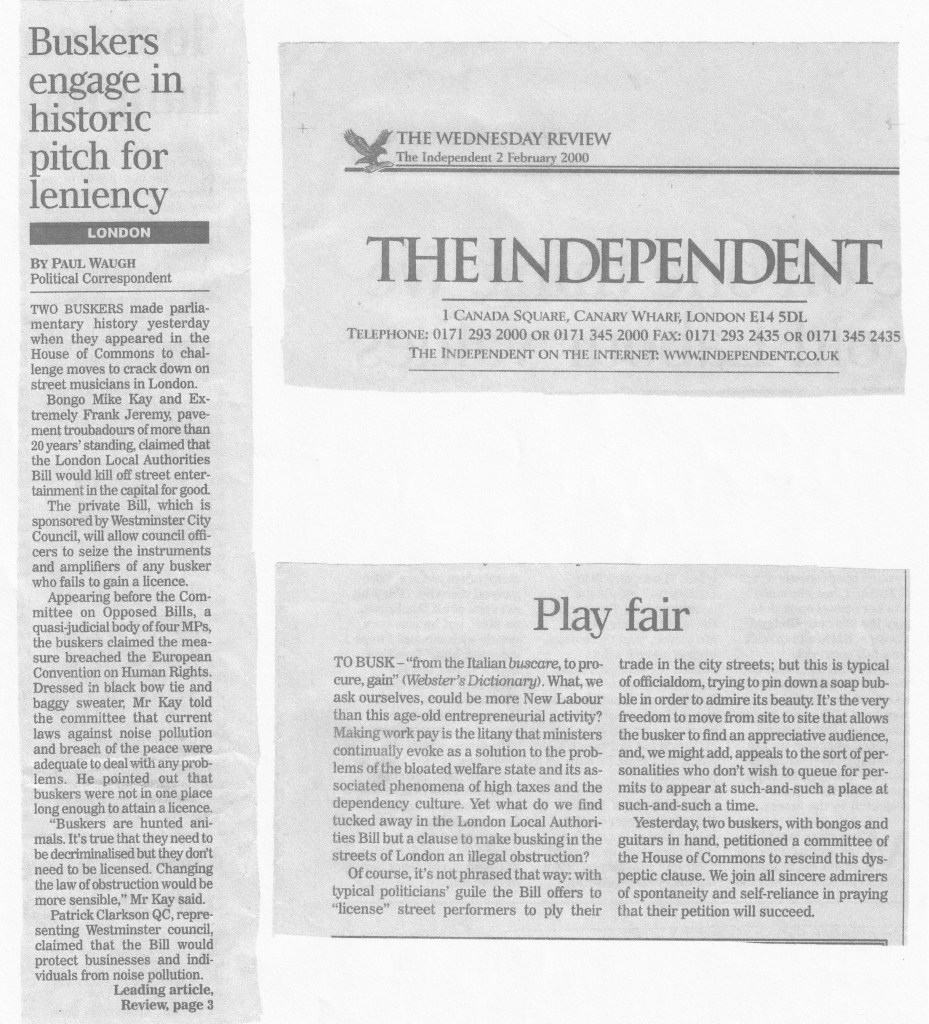
“Well that’s all very well”, I hear your inner bureaucrat objecting, “but how then is the whole thing ever to be regulated to everybody‘s satisfaction?”

Let me give full disclosure here – Bongo Mike and I did once obtain a licence, in 1997, to perform on the trains of the ‘S’ Bahn system in Nordrhein Westphalen, Germany, but only as a novelty for a brief period of two weeks, and the experiment – although quite successful – was not repeated. And as I have said, such performances remain illegal on all of Britain’s train systems.

A variation in the legislation regarding street music in London and elsewhere in UK has meant that busking in the street is no longer treated as a matter for the police in the first instance – except, presumably, in extreme situations which might arise in any case. It is now a matter between the performer and the local authorities, who react in different ways, along the tolerant/intolerant spectrum. So far, so quite a bit better, and a vindication I like to think, as far as it goes, of the stand taken by Bongo Mike and myself on the whole issue – controversial though it was at the time. But uncertainties and injustices remain. Busking – to use again this word I don’t really like – is a culture in its own right, and attempts that are made to bring it out of the twilight where it has lingered for so long usually seem to go wrong. It is so much a thing of the moment, and that’s a very difficult quality to capture in any broader structure….

….and it is on this note, dear reader, that I must sadly take my leave of you – for now – pausing merely to remind you of my oft-repeated mantra, that answers concerning the right treatment of street musicians, buskers etc. will be hard to come by until Situation Art is inducted, in one guise or another, into the pantheon of intellectual respectability, and it is accepted that there is an aesthetic proper to spontaneous public place performance alone.

See you next week!

Where Does The Music Go To ?

It’s a Friday morning in early 1974. I have gone with Bongo Mike to the Covent Garden Community Centre in Earlham Street, Central London, because a jazz group that’s going to be playing there at the weekend will be performing some of his songs as part of their set, and he’s going to be doing a spot himself. There’s just been a general election the day before, and we sit around watching late results as they come through on the TV, while we wait to see Mike’s contact at the Centre, and discuss tomorrow’s concert. (Harold Wilson won, by the way.)

So now it’s Saturday evening, and a group called Okuren, featuring singer Maggie Nicols, are playing – including, as mentioned, four songs co-written by Mike. The lyrics of the songs have been written out with illustrations, in Mike’s trademark style, and displayed at the front of the stage, where Maggie can point to them as she introduces and sings each one.

Living A Life Of Ease – one of four “Street Sketches”

Over the years that followed I would run into Maggie from time to time, generally when I was with Mike, and once or twice we met her daughter Aura – and in between, Mike would fill me in about how he got to know them…

It was in the early 60’s. Maggie was working at the famous Windmill Club as a “Windmill Girl”. After the show the girls would chill at a hang-out called Le Duce in D’Arblay Street, and who should Maggie get into conversation with but a young drummer called Mike Koskie (later to re-brand himself as Bongo Mike), who was a “face” round Soho clubs in those days. One of the topics of conversation was how Maggie had an ambition to be a jazz singer…and she credits Mike with having been the first person on the scene to take this idea of hers seriously, and encourage her.

With regard to her subsequent lifelong career as singer and activist, let me provide a link to Maggie’s website .

Though not a street musician, Maggie was always a supporter of the cause we had given ourselves to, and although very busy with her own involvements, she did support us – along with Aura – at demonstrations against the heavy-handed busker licensing schemes, notably those proposed by London Underground and Westminster Council, which seemed to be the official answer – in the early 2000’s – to our campaign about a better deal for street musicians. Below is a clip from BBC local news coverage of one of these:

Demonstration in Leicester Square, Nov 2002, with Maggie supporting, against Westminster Council’s plans for a wide-ranging licensing scheme to control busking in the centre of London. The musical performance was with pots and pans, to highlight the fact that under the new scheme the police would have the power to confiscate musical instruments.

At around the time when these licensing schemes were being put forward, or maybe a bit earlier actually, Mike and I were in Skopje, Macedonia – a place which often felt like our second home in those days – and having there the peace of mind to be creative, we wrote between us a song called “Where Does The Music Go To..”. We asked Vlatko Kaevski, a Macedonian musician and associate of ours at that time, to make an arrangement of the song, and started wondering who might sing it.

Back in London we played to Maggie what we had already got together, asked if she was interested, she suggested she might do it along with Aura her daughter, since the song works best with two singers – and the result, renamed as “A Secret Love”, can be listened to below. I have always particularly liked this lyric of Mike’s, dancing as it does between artistic censorship and sexual repression.

The Fightback (1)

PROLOGUE

In the photo above we are playing outside the London Experience, as it was known then, in Coventry Street.

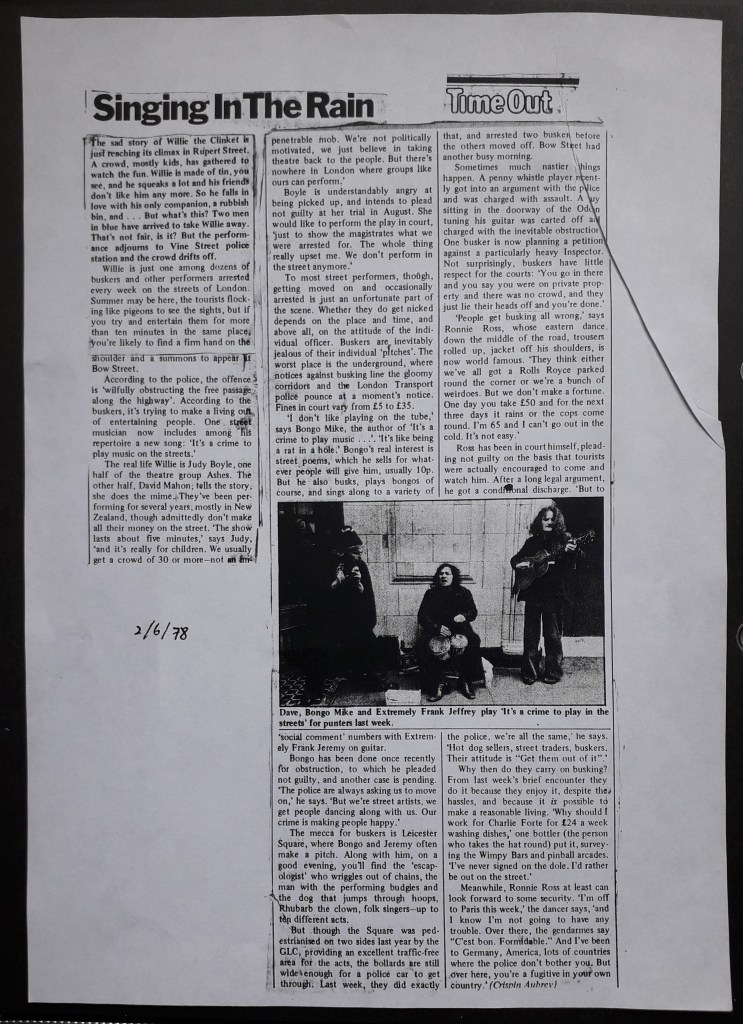
Right from the start of our busking partnership in Spring 1978, we – aka Bongo Mike and I – were unhappy about our situation as buskers in London generally, and in the West End in particular. After several months of being continually ordered by the police, for no apparent reason, to “move on”, and being then arrested and prosecuted if we resumed playing after they had gone – or even if we were simply rash enough to protest – we eventually reacted by contacting Time Out (in those days a fairly radical magazine) with the whole woeful story of the game of cat-and-mouse endured by buskers all over the capital.

Shortly after the article appeared we followed the recommendation of a Belgian visitor to London with whom we had got talking one day, during a break in our performance, and left these shores for Antwerp…. and beyond. For four years we were no more than occasional visitors back to the UK: NFA (no fixed abode), as the British police would so charmingly designate our status; or nomads, as we saw it, carrying with us, wherever we went, our musical instruments and a large army-surplus kit-bag.

Two places stood out as the only fixed points in our life – i.e. places where we knew we could simply turn up, no questions asked, no matter how low we had got, and just sleep, rest, recover, regroup, etc. These were Wädenswil, in the canton of Zurich, Switzerland, at the home of a journalist friend called Arthur Shappi; and Hotel Shar, in the Stara Charshiya district of Skopje, Yugoslavia.

In the courtyard of the Hotel Shar, throughout the days of summer, there stood tables served by waiters from the associated Restaurant Shar – or PECTOPAH ШAP as the name was displayed, in Cyrillic lettering, on the signboard outside

Belgium had become the centre of our performing life; but Switzerland and/or Yugoslavia were our places of last refuge….

….and as for Britain, where we had now no income or base, it was just a place to which we could make occasional nostalgic forays of one or two days duration (or slightly longer if we could connect with someone we used to know, or find an empty building to squat in, such as the deserted houses on Railton Road in the aftermath of the Brixton riots of 1981).

FOOTHOLD

But all this was to change in 1982. On a train journey early that year from Leuven (the centre of our cafe musician business) to Hasselt (a town in eastern Belgium where we had many times performed), the train had developed an electrical fault and was kept stationary between stops for maybe half an hour. Sitting there with instruments primed and ready to play in the cafes of Hasselt, in a carriage full of people bored and increasingly annoyed at the delay…well, wouldn’t you have decided to just break into song for the fellow passengers, and go round with the hat? It was, after all, not that different from what we would eventually be doing in the restaurants and cafes in Hasselt – if we were ever going to get there!

So we did it, right there, on the train.

Then on a brief return to London in Spring, shortly afterwards, we got talking in a cafe near the Oval to a friend of a friend who invited us to stay temporarily in a spare room in a housing co-op nearby….and, well, the respite thus gained did allow time for an idea to cross our minds, that some tube lines, being situated above ground rather than underground, might be quite suitable for a repeat of what we had done recently on the Belgian train.

But controversy struck from the very beginning. On the first train carriage we tried, a gentleman announcing himself as an employee of the tube started shouting at us and ordered us to stop. Seeing discretion as the better part of valour, we got off the train, boarded the next one, and tried again; this time we were more lucky, and thus emboldened we continued for some time, playing two or three songs on each carriage before taking the hat round, in the time-honoured manner of gipsy-style players – such as we had indeed become on the other side of the English Channel – or indeed, of good old British buskers.

We experimented on various lines with varying degrees of success for a week or so, before returning to Belgium. Significantly, the level of official interference was sufficiently low for there to be an apparently viable modus vivendi in it.

And after as momentous an event in our lives as that had been, it was – I suppose – only a matter of time before we would relocate back to London.

In the event, it took about six months.

LEGAL CONVERSATION

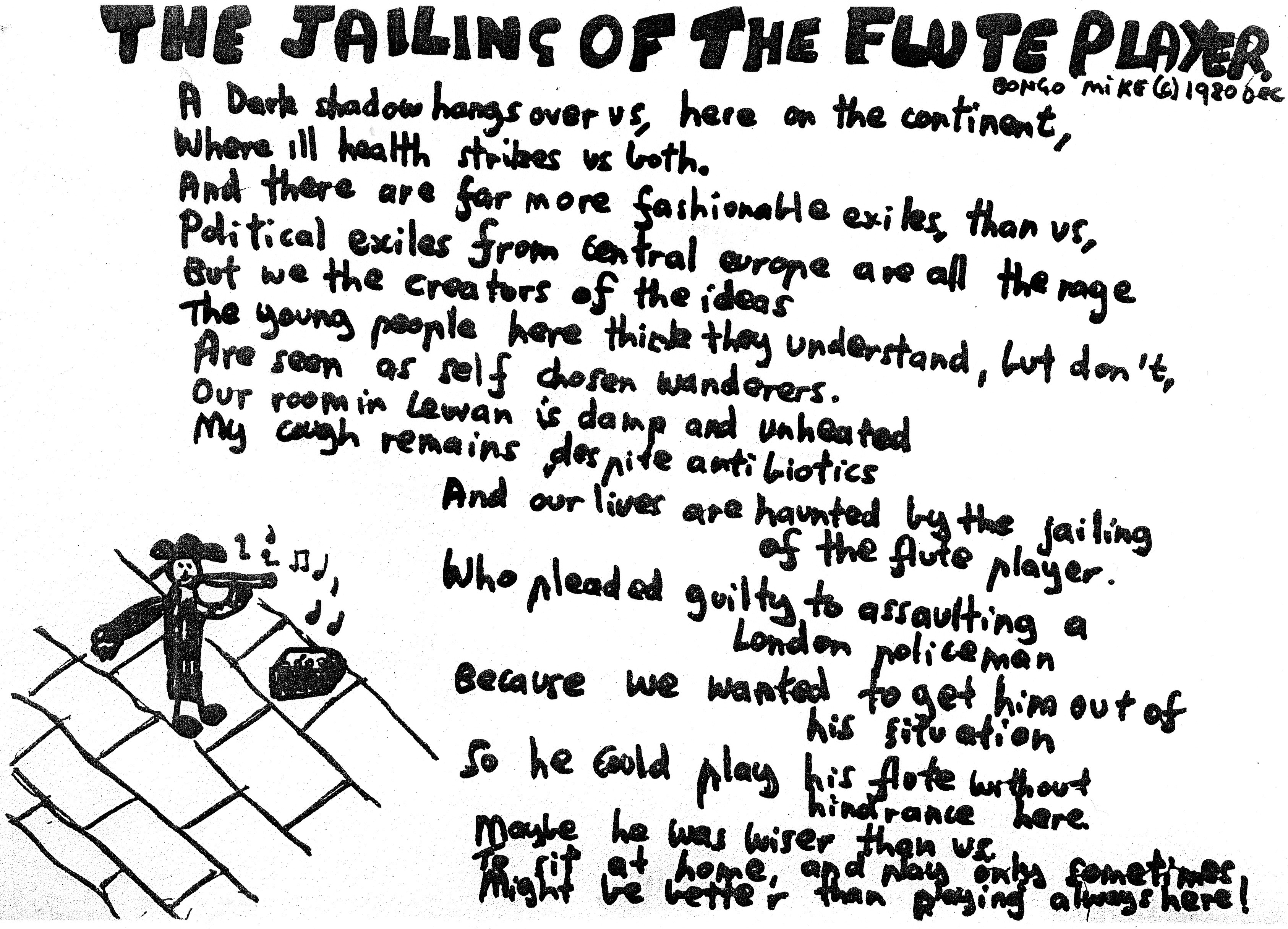
But in the intervening Summer in Leuven we met by chance – while performing to a terraced street cafe – a law professor at the University there, called Raf Geraert. We were explaining to him some extremely distressing aspects of our situation – specifically, the insecurity stemming from the lack of residence rights in Belgium and the continent broadly, and this coupled with the lack of right to perform in public places (to put the case mildly) in UK. In this connection, I present here a relevant poem of Mike’s:

A poem by Bongo Mike, one of an unpublished series called “Living In The Gutter” which he wrote in the early 1980’s while we were working abroad.

M. Geraert came up with no specific suggestions on this occasion, as I remember, but his grasp of what we were talking about, which few people in those days took at all seriously, impressed us, and opened a new chapter in our minds – if nowhere else, at that stage.

LONDON AGAIN

So, anyway, come Autumn 1982, with new confidence, probably derived from the fact of having glimpsed, however dimly, a way forward, both at a practical and a conceptual level, we came back to London determined this time to find a place to stay, and ran into some luck – a chance meeting in Barclay’s all-night cafe in Whitehall led us to a house in Elephant and Castle where lived a bottler for one or two of the West End buskers (a bottler is the person who takes the hat round when a crowd gathers), who seemed happy for us to sleep there for a while, making it possible for us to explore the possibilities of our new job (busking on trains), start to re-orientate ourselves to the situation in London, and hopefully reconnect with friends from the past.

There was a largish number of musicians who performed underground at Tube stations, in passageways or sometimes at the foot of escalators. This was, of course, illegal – posters announcing the fact were placed everywhere on the walls, and there was a permanent risk of being stopped by members of staff or Transport Police, and further of being charged with a bye-law offence and receiving a fine. This hadn’t appealed to Mike and me in 1978 when we first started playing together, and it still didn’t.

In parallel with this there was, performing in streets mainly in and around the West End, a certain community of more traditional buskers, most of whom we knew from our time in London in the 70’s. There’s was also a fugitive kind of existence, in and out of police stations and Magistrates Courts – precisely what we had left the country to avoid; and even if there could be periods when the heat seemed to be off, the threat was always there.

Henry Hollis, Ronnie Ross and Charlie Hillard (performing as THE ROAD STARS ), and a one man band, represent “eccentric” Britain at the International Trade Fair in Montreal, in 1967. Although the commentary describes them as bringing “the atmosphere of Leicester Square” to the proceedings in Canada, they would of course be regularly arrested when performing this act in Leicester Square.

And lastly, there was just one person who was already playing on the trains – of the Piccadilly Line: a lady called Elsa, who played guitar and sang folk songs with a beautiful and powerful voice, her boyfriend always somewhere nearby, mingling discreetly with the passengers in case of trouble.

We took to performing on trains like ducks to water, concentrating in the early days on the branch of the Piccadilly Line which went to and from Heathrow Airport.

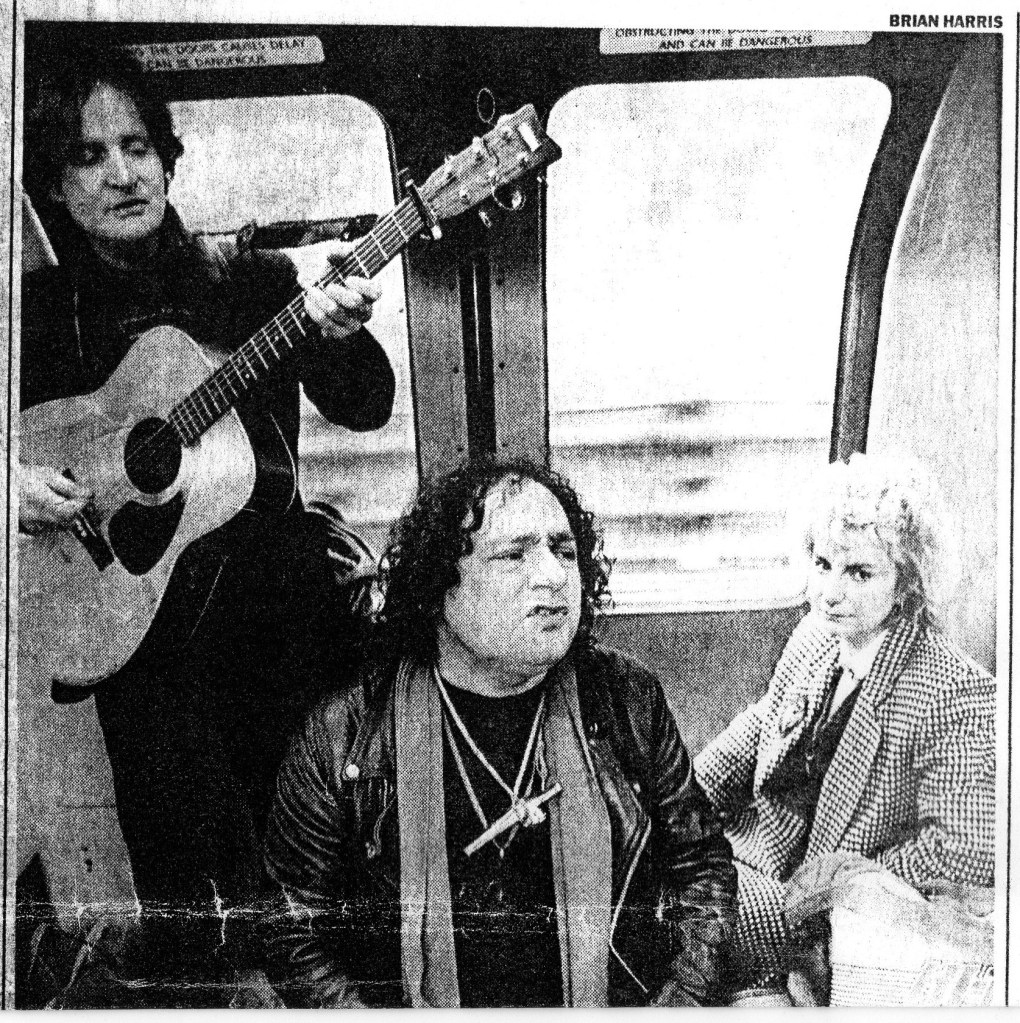
Bongo Mike and Extremely Frank Jeremy performing on the Heathrow line, 1980’s. {Photo: The Independent)

Our bottler friend in Elephant and Castle would be visited at all hours of the day and night by other members of the Soho fraternity: Scotty the one-man-band; Roy “Little Legs”, at 4′ 2″ probably the shortest busker you would run into; the Earl of Mustard, aka Norman Norris, tap dancer “extraordinaire”, self-styled “King of the Buskers” and even, in a considerable flight of fancy, “King of the Squatters” (“everyone who shares a squat with me ends up with a council flat”); and – on a brief visit to London from his then home in Copenhagen – Don Partridge, of “Rosie” fame.

At some point in December we were surprised to see – quite by accident – an article in The Times featuring an interview with a gentleman called Allan Bernard who was running an agency which apparently represented the interests of, and found occasional “professional” work for, a number of the more traditional type of buskers I’ve just been talking about. He gave an interesting appraisal – which echoed our views precisely – of the uselessness of licensed situations such as existed in Covent Garden at the time:

“The Covent Garden system is fine for young music and drama students, guitar strummers and newcomers generally. But it has developed into no more than open-air concerts with, in some cases, benches provided for the audience to sit and watch at certain set times. The art of busking is not just playing an instrument, juggling or tumbling, it is also about how to work a street corner or pavement and the ability to relate very rapidly with a constantly changing audience…”

But sadly the article itself said nothing about the real life situation of constant harassment and arrests for those who practised the art of busking thus described, and was rounded off with an absurd reference to what the journalist called “a renaissance of street life in London”, sacrificing – as it seemed to us – what working buskers knew to be the truth, in favour of a facile up-beat conclusion.

We duly contacted the journalist, Mr Tony Samstag, and explained our points to him. He was reasonable enough to take on board what we said, and on January 4 1983, some three weeks later, we were very happy to see the following article in the same paper:

What we were not expecting, was that many (though certainly not all) of the buskers around at that time would actually be quite hostile to us, and would not support our stand at all.

Nevertheless our blood was up, and though – sadly – we didn’t get the asylum in Belgium, we had a further conversation over there with our law professor friend (see above), who recommended that we try our luck with the European Court of Human Rights.

The progress of our – ultimately unsuccessful – application at the ECHR is detailed in an earlier post, “The Casebook of Bongo Mike and Extremely Frank Jeremy (1)”.

But there were further actions in UK!…..(to be continued.)

Buskaction – and beyond

Buskaction was the first, the original campaigning website concerning itself solely with buskers’ rights. It is still reachable at its original web address bak.spc.org/buskaction but we have not updated it since 2013 – that being the year when Bongo Mike became permanently bed-bound and I became his principal carer, and we decided it was the right moment to let the baton pass on to others.

So the names and faces of campaigners doing stuff may have changed; and I am aware of some local improvements for buskers, made by enlightened authorities, which give me hope that our energies weren’t completely wasted…. but then the legal battle, for us, was only ever a first step in the struggle to get busking seen as a type of art in its own right.

Buskaction went online in 1997 when James Stevens, a forward-thinking philanthropist from the then fast-expanding world of cyber-culture, offered us the chance to create our own space on the worldwide web, from which to co-ordinate the ongoing struggle for a better deal for buskers – well, worldwide!

We had of course been single-handedly fighting our corner in the UK through the British and European courts of law – and generating much publicity for the cause – for the previous fifteen years [see Casebook (1) and Casebook (2)], but had in 1996 joined forces with another group of buskers from the tube, who called themselves the London Public Entertainers Collective, and who had shortly beforehand followed our earlier lead in taking the path of legal action themselves – contesting busking prosecutions and generating further publicity on their own account.

We went with some members of this group to James Stevens’ Cyberlounge – Backspace – in Clink Street SE1, and there we constructed, with James’s enormous and patient help, the first few simple pages of bak.spc.org/buskaction , including as a special feature the “world premier” of the music video of our protest song “Don’t Know Why”, embedded in the site with Quicktime – YouTube still being eight years away!

BBC Radio 1 Newsbeat attended the launch party for Buskaction, in March 1997.

The visuals are made up of stills captured from the music video of the song “Don’t Know Why”, referred to in the broadcast

Then on 22nd Oct 1998 we launched our CD protest single at the Vibe Bar in Brick Lane.  The record contained songs of ours, protesting against limitations of public place performances, including “Don’t Know Why” and “Its A Crime To Play Music in the Streets”.  Both BBC and ITV local news ran the story announcing the release of this protest single, screening excerpts from the music video of “Don’t Know Why”.

BBC London Local News October 1998

Within a short while, both London Underground and Westminster City Council announced plans for licensing performances on the tube and in the streets of London, having somehow simultaneously decided that busking could make a contribution to the colour of the city, whereas they had both up till then treated it as an unwanted nuisance. Maybe they saw licensing as their best (or indeed last) hope for controlling things, now that the time-honoured practice of leaving it to the police was gettng a bad name; and maybe they were frightened by a ruling in the House of Lords at about the same time, overturning a prosecution of demonstrators at Stonehenge, and pronouncing crucially that  “the law today should recognise that the public highway was a public place, on which all manner of reasonable activities might go on”.

But whatever their arcane thinking may have been, certainly in neither case – tube or street – had they made any attempt to canvas opinion from regular buskers as to what sort of arrangements would or wouldn’t work to bring about an end to the official bullying and harassment suffered for so long by street and tube performers. Both organisations put forward ill-thought-out, non-consensual, top-down schemes which, far from improving life for performers, threatened to make it even worse: by failing to incorporate the ad hoc, freewheeling character of the busking phenomenon; by breaking up the informal arrangements which would spring up from time to time and from place to place between officialdom and “buskerdom”; and furthermore, by starting to give credence to a new concept of “unlicensed busking” as an automatic offence, on a par with begging.

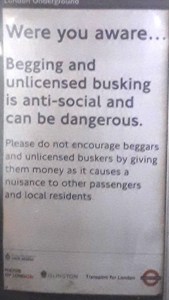
This poster which appeared in a subway near to Old Street tube station, in London, some time after the advent of the licensing philosophy, tells its own story. Added to which, a prosecution mounted as late as 2009 against London busker Bernard Pierre, which attracted some interest from the press, threatened to give this dangerous idea some legal validity.

Fortunately the danger of some kind of ugly low-level precedent being set, whereby an “unlicensed” busker could be considereded equivalent to a beggar, was averted by virtue of Bernard’s successful appeal against conviction.

Others will doubtless be more up to the minute than I am with busking politics in this post-licensing schemes world. Schemes put on the table by Camden and Westminster Councils have been hotly contested. I would think the main basis for hope on the street – despite the shaky start described – is that many councils have simply not bothered with setting up schemes of the type envisaged by Westminster; and that further, as the years have gone by, the Police have in many areas backed off anyway, apparently happy to leave it to council officials to boss around or not boss around street musicians, as the case may be.. Sadly, however, that’s not to say that vindictive anti-busker attitudes and/or regulations are simply a thing of the past.

As I mentioned above, I have – when it comes to street playing – largely hung up my boots; though not without a brief re-incarnation in 2021/22 as a one man band, which I undertook partly to experience the feeling of “going it alone” (albeit I was often accompanied by blues harpist Mal Collins), and partly to celebrate the partial decriminalisation of busking that had been achieved after so many years. I did have the enormous satisfaction of being able to perform with impunity outside Earls Court tube station, a spot from where Bongo Mike and I had been comprehensively bundled off by the Kensington Police some forty years previously.

Nor, in fact, am I completely ruling out further “nostalgia” busking pitches in the future, wherever my remaining years may take me. You just never know what the future might bring. But this blog is, unlike the avowedly campaigning site Buskaction, primarily the story of a personal journey.


“This is Earls Court. Just outside the tube station. I’m singing a song called Midnight Special. It’s a song about being released from prison. I see it as quite a religious song. When Bongo Mike and I started busking in London, this was one of the first pitches we found – playing, well, almost where I’m playing now. But the trouble was, in those days you could only last for about twenty minutes (or maybe slightly longer if you were lucky). The police would come along, and say, “Just moving on were we”; or some kind of friendly greeting like that we used to get. And after a while of that it was getting very difficult to co-exist with all that, and so we went over to the continent, I’m talking about 1978, and for the next thirty years we spent a large part of our time on the continent – as we saw it, in exile, really. But we used to come back of course, and while we were back here we used to try and fight against the situation in any ways that we could. We took quite a lot of court cases and got quite a lot of publicity, in fact, for those court cases, and in the end – probably more the publicity than the court cases – actually started to have an effect because it was rather bad publicity for the set up here. And round the turn of the century – around that time – a lot of changes started to happen. Now change, it can be for the good and it can be for the bad, and where it was for the bad was that you got all these awful licensing schemes coming in – on the tube, and lots of towns, and boroughs in London started all this licensing – which wasn’t too good. But the good thing was that it was sort of taken out of the hands of the police, and the way it was going to be handled was put in the hands of the local governments, wherever. Well as time has passed, since it all started, the attitude has started to mellow quite a lot, and busking in the street is in many ways a thing that you can do now without too many of those type of problems. So I sing this song now with a sense of, well, triumph really, ’cause…..we got out of prison.”

A Bunch Of Keys

“Every lock that ain’t locked when no-one’s around”

Travelling from one pitch to another, making friends, being offered hospitality in many towns – our lives were ruled by the twin necessities of finding places to perform, and finding places to get a night’s sleep.

These keys fitted locks of all different addresses in many countries. Some of them unlock doors in the memory too.

Like this one for example – a hotel room-key we accidentally walked off with.

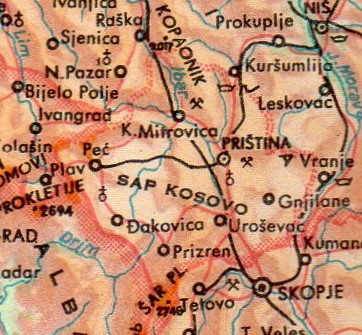
It was 1980 ( I think, though it could have been ’79). We were having our customary late Summer break in the Balkans, and decided that, rather than spend the whole time in Macedonia, we would make a tour round nearby Kosovo – similarly, at that time, a part of the now-disbanded Yugoslavia, being a designated “autonomous region” of Serbia.

We stayed some nights privatno – that is to say, in unofficial lodgings – in Pristina, the main city, and then struck out for Peć (pronounced Petch), a city surrounded by mountains, which we had been told was very beautiful.

Kosovo and surrounding areas of Macedonia, Albania, Bosnia and Serbia. The thin black lines are railway lines; the thin dark-red lines are main roads connecting large towns; the red-lines with fine cross-hatching attached denote a border between different countries, or between republics within Yugoslavia; the green lines are rivers.

Hitch-hiking was rather slow, and by evening we had still only reached Kosovska Mitrovica, where we broke the journey to get a meal in the self-service restaurant (every town of any size in Yugoslavia boasted a state-owned, low-priced, self-service restaurant) before returning to the road and attempting to resume the journey. Lifts were still not forthcoming, and we got into conversation with a visiting student from Syria who happened to walk past where we were standing, and who offered to put us up for the night in a room he rented from an Albanian family living nearby.

The following day we made it to Peć, which was – as expected – very picturesque, and we settled in for the night at the local campsite, just outside the town, which also had a few rooms. There was a band playing in the evening, Albanian dance music – or “new folk”, as the pop music with a local flavour was generally called. However the band, as was later explained to us, performed some songs which were possibly expressive of Albanian nationalist aspirations, the police appeared, and the fiesta was dispersed.

I want to stress that at this time Mike and I knew nothing of nationalist movements within Yugoslavia – we had not the slightest interest in local Balkan politics, being quite fascinated by the glimpse we were getting of life in a communist society, co-existing as it did in Macedonia (and to some extent in Kosovo) with the remnants of five hundred years of Turkish occupation. Moreover the members of the band, with whom we spent some time after the closing down of the evening’s entertainment, were talking of their interest in the music of Deep Purple and Santana rather than in anti-government sedition. As professional musicians, they had merely been carrying out what is expected of professional musicians the world over, aka playing what the guests ask them to play.

And so onwards the next day, with Prizren as our objective – described to us by all and sundry as an interesting town with many remaining buildings from the Turkish era, although little-known in the west, except perhaps today as the home city – as I have heard – of the family of singer Dua Lipa. Our bad luck with the hitch-hiking persisted, and by the early evening we were happy to accept a lift from the only car that had stopped all day, even though it would take us no further than Đjakovica, a small town halfway to Prizren. The two young men in the car spoke no English and we no Albanian, or – at that time – anything much more than a few words of Macedonian, so conversation was difficult.

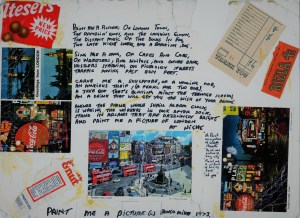
Shortly before we arrived in Đjakovica a police car overtook us and signaled to the driver to stop. After a brief conversation with the driver and his friend, the two policemen ordered Mike and me to step out of the vehicle we had been in, beckoned to the young men to move off and to us to get into the police car, and then drove us to a nearby police station. There we were questioned about what we were doing in Yugoslavia, how much money we had etc, our bags were opened and searched, and a sheaf of illustrated poems about street-life in London, written by Mike, seized upon and apparently confiscated.

“Paint Me A Picture” an example of the poems which were seized. There are twelve of them – all a little distressed from their travels around Europe in Mike’s bag – together forming a series entitled “Blues On A Windy Day”

We were given the option either to spend the night in the cells, or to leave our passports with the police and spend the night in a hotel. We opted for the latter and walked into the town, somewhat bemused by the turn of events – although, looking back now, it was not so very different from things that were happening closer to home in those days, except that the fear factor maybe increased with the greater cultural distance.

And so we arrived at the Hotel Pastrik, in Đjakovica, recommended – as I remember – by the Police for its reasonable prices. The receptionist understood the situation; after an uneasy night’s sleep we dressed and headed for the Post Office, where we had been informed we could find a long distance-telephone, which we needed in order to put into effect the plan we had formed to call up the British Consulate in Belgrade There was a considerable queue, and as our impatience boiled over we started to get an unusual sensation – for us, at least – of being like visitors from another planet. Some shouting took place.

Eventually we got our phone, and were able to reach the British Consulate, where a typically polite, phlegmatic English person listened to our story and undertook to speak on our behalf to a contact in the Belgrade Police, whom he thought could straighten the matter out for us.

He advised us to call back in about half an hour, and after an anxious wait we spoke to him again. He had – as he had promised – sorted it out; we were to go back to the Police Station, where our passports and Mike’s poems would be returned to us. Whatever the reality, there had clearly been a decision to call the incident a misunderstanding: there were, one could easily suppose, not many foreign travellers of any description who visited Đjakovica, let alone two dangerously long-haired guitar-carrying scruffs like us.

Anyway, thus re-assured we attempted to make our peace with the people around us in the Post Office queue, at whom we had not long ago been exploding in frustration, and then made our way back to the Police Station. We were met at the street entrance by an officer who formally handed us our possessions and gave a kind of salute, for which we thanked him, before going on our way – only to find, once safely en route to Prizren (on a bus this time), that we had made off with our door key from the Hotel Pastrik…….

The poem “Paint Me A Picture” exhibited above, one of those which had excited the Đjakovica police’s suspicions about us, was also (along with the other poems in the series) a song lyric. Some ten years after the events related here, we recorded the song in Skopje, with a Macedonian arranger/kerboardist called Vlatko Kaevski.

The picture here is from Mike’s days as a street poet in London

Ten years later still, we became friends with an Albanian language singer from Skopje called Eroll Jakupi. This below is a video of him performing one of his own songs, QindperQind (or “One Hundred Per Cent”, in English), at a song festival called Polifest, in Pristina in 2003, where he won the gold award for best song that year.

A Thing or Two About Stations

Visiting Paddington Station in 2022, while taking a first ride on the newly-opened Elizabeth Line, I’m reminded of an involvement with this same station (one I hardly use these days) way back in the 1970’s, when I was a new boy in London and spent several years distributing poems – street poems, as we called them – in streets and railway stations, primarily around London, but also in many other towns up and down the country.

This was at the instigation of Mr. Bongo Mike, who was already well-known as the London Street Poet when I met him.(Actually he was the second London Street Poet, the first one having been Street Talking Pete, but he was no longer active at this time.)

So we’re back in 1975, I’ve joined Mike in his literary venture, distributing a few of my poems and some of his, making a precarious but hugely satisfying living at it, and I’m on the concourse of Paddington Station one Sunday afternoon in June, making a sales pitch in the manner first demonstrated to me in Victoria Station by Mike himself, approaching people randomly with some such line as, “Hello, I’m a street poet, would you like a poem to take home with you”, or “…I’d like to give you a poem to put on your wall” (Mike’s favouite), or….well, any one of various other lines you might think of.

Paddington Station as it is today – renewed, but not wholly different from how it was in the 1970’s

Well, I have noticed a uniformed police officer some way off, who I think may be observing me, though I’m not sure. After a few minutes he does approach me, saying “Can you come with me to the office, I want to talk with you”.

I say, “Well, can we not have the conversation here? I mean, if you want me to leave, I’ll just go, no problem” (Or words to that effect. You would technically need a licence to distribute printed matter in a train station, though if you just “got on with it” you were usually ok – but if the police got involved you would have to disappear, and maybe give them a few free poems, depending on their mood!).

He insists that I go with him, so I do, and once inside the office at the edge of the concourse I am verbally assailed by two other officers, who accuse me of being a vagrant, and make various other derogatory remarks. I suppose I might have become a little heated myself, and the eventual result was that I was driven off to Paddington Green Police Station where I was put in a cell for a while, before finally being informed that I was being charged with trespass on the railway, and should appear at Marylebone Magistrates Court the following morning.

My charge sheet. The description of the offence, which is on the reverse of this document, is all but illegible, but does in fact state “That you on Sunday 8th June 1975 at Paddington Railway Station did willfully trespass upon the railway or other works or premises connected therewith and refused to quit upon request made to you by an officer of the Railway. Contrary to Section 16 of the Regulation of Railways Act 1840, as amended by Section 35(1) of the British Railways Act 1965.

When I saw Mike that evening he said “Oh well, maybe it’s a good thing. You’ll find it very character-building fighting a court case. Go to a library and study the law books. You should represent yourself.”

So I did. And because I pleaded Not Guilty, the hearing was postponed at first until the end of July, and then again until the end of September. By chance I ran into an old school friend who had been at Cambridge with me, and was now working at the Home Office, who agreed to come as a character witness; then a former teacher from the same school, and a vicar who lived across the road from where I was squatting, both gave me written character references; and I had a few meetings with a young lawyer who gave me some advice pro bono on procedural matters at court.

In those days, as the accused, you knew only what was written on your charge sheet, i.e. what law you were accused of breaking; you did not know, in advance, what account the arresting officer was going to give, in the courtroom, of what it was that you were doing that caused them to arrest you. I believe this practice has been changed in the meantime, but it meant then that, as the defendant, you had no idea what story the officer was going to tell. (Or as a cynic might put it, what lies he was going to dream up!)

As rebuilt in 2011, and re-styled Westminster Magistrates Court, inorporating the old Bow Sreet, Horseferry Road and Marylebone Magistrates Courts
Marylebone Magistrates Court as it was in 1975

For months I worried and fretted, preparing my case, based on what I remembered of the event; but when the day came the policeman told a story that was indeed – I’m sorry to say – a work of pure fiction. He told the court that he had seen me follow two old ladies around the station and look in their handbags, and that when he spoke to me he had ordered me to leave the station, but I had refused to go.

Now that, looked at rationally, does seem to be an implausible scenario on two counts – not merely because a saint such as I am (!) would simply never do such a thing, but because, even assuming I had, surely the last thing I would then do, upon realizing that a police officer had been watching me, would be to refuse to leave! It makes no sense at all.

But I had – naively, I suppose – been assuming that his story would in general terms resemble the facts as I remembered them, and I had prepared some searching questions to ask, on that basis. As it was, I was completely flabbergasted. I blustered to no real effect for some minutes, but really could think of nothing better to say than to demand to know from the J.P.’s if I was being charged with trespass on the railway or with looking in ladies’ handbags.

The J.P.’s confirmed that the handbags were not included in the charge. And when the time came to give my evidence, I obviously presented the picture of events as I remembered them – much as I have described them above. My character witness confirmed that he had known me at school and at Cambridge, and that he didn’t think it was probable that I would be looking in strange ladies’ handbags in a railway station.

And in my summing up I argued that, if my evidence were to be believed (and really it was the more credible account) then whatever the rights and wrongs of my selling poems on the station concourse, I couldn’t be guilty of trespass because, far from refusing to leave, I had in fact offered to leave, but had been detained at the officer’s insistence.

[The law of trespass – which curiously is only a criminal offence where it happens on railway property – actually describes the forbidden act as “wilful trespass”, which in practice means that you have to have been given a warning, and have then refused to leave, before you can be considered to have broken the law.]

The J.P.’s retired, and on coming back returned the verdict of guilty: there had been a technical trespass, but they would give me an absolute discharge. And the clerk of the court came up to speak to my witness and me afterwards, and informed us – in a friendly sort of way – that he’d been to Oxford.

Which was all sort of pally and alright, in the sense that I didn’t suffer a punishment, and more importantly didn’t have a criminal record, but it did feel like an illogical fudge, and if I had not already been driven mad for four months worrying about the whole thing, I might even have appealed. But it was going to be a difficult business trying to distribute poems at Paddington station in future anyway, even if I did win an appeal. So on balance I decided to just swallow it – which was of course a bit sad, because the street poems had actually been quite popular in Paddington . But there were other stations to try…

….one of these being Kings Cross, where there was both a concourse for the mainline station at street level, and beneath that, at a lower level, a ticket hall for the tube station (both of them suitable locations for my work); meaning that I was to become familiar, over several years, with the layout of the station itself, and with the network of passages connecting the underground ticket hall of the tube station to both the mainline concourse above, and to the street outside and even to the nearby St Pancras Station. And thereby hangs a tale, which I shall leave for another day……

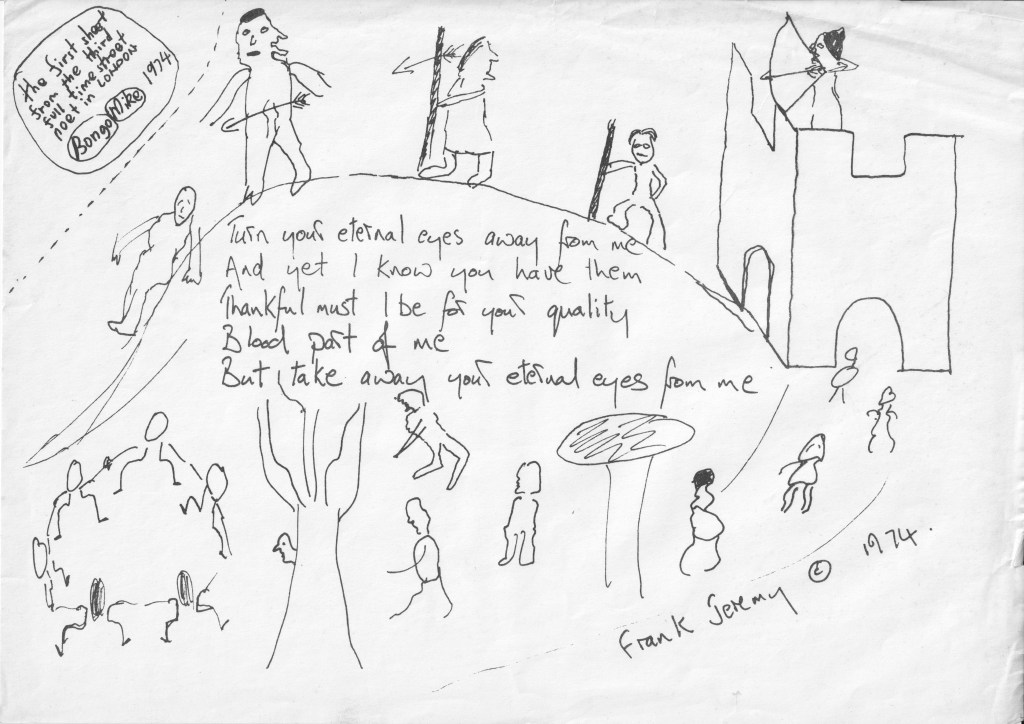
I reproduce here the first street poem I published and sold on the streets, after being encouraged by Bongo Mike to join him, using the artist name Frank Jeremy. And when some time later I took up playing the guitar again, performing as a duo with Mike, I was renamed Extremely Frank Jeremy

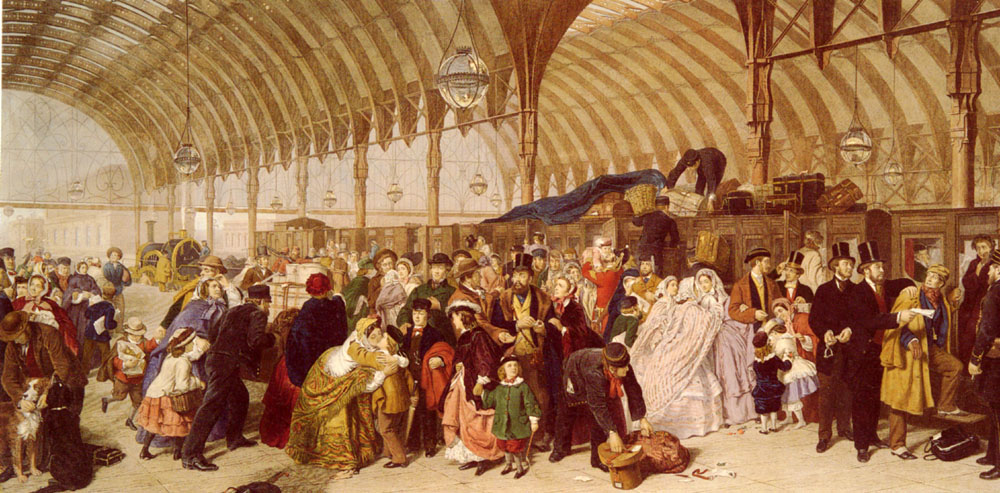
And lastly a picture of Paddington Station, entitled simply “The Railway Station”, completed in 1862 by the British artist William Powell Frith, who specialised in painting crowd scenes of everyday life.

The Railway Station by William Powell Frith 1862 Public Domain

The two gentlemen in top hats on the right of the picture (one carrying what looks like a set of handcuffs) are apparently police detectives, apprehending for unspecified reasons a gentleman who may be having his shoes cleaned – the incident being observed by a station porter on their left. Perhaps the gentleman in question had been trying to sell his poems? (Let’s hope he hadn’t been looking in old ladies’ handbags!)

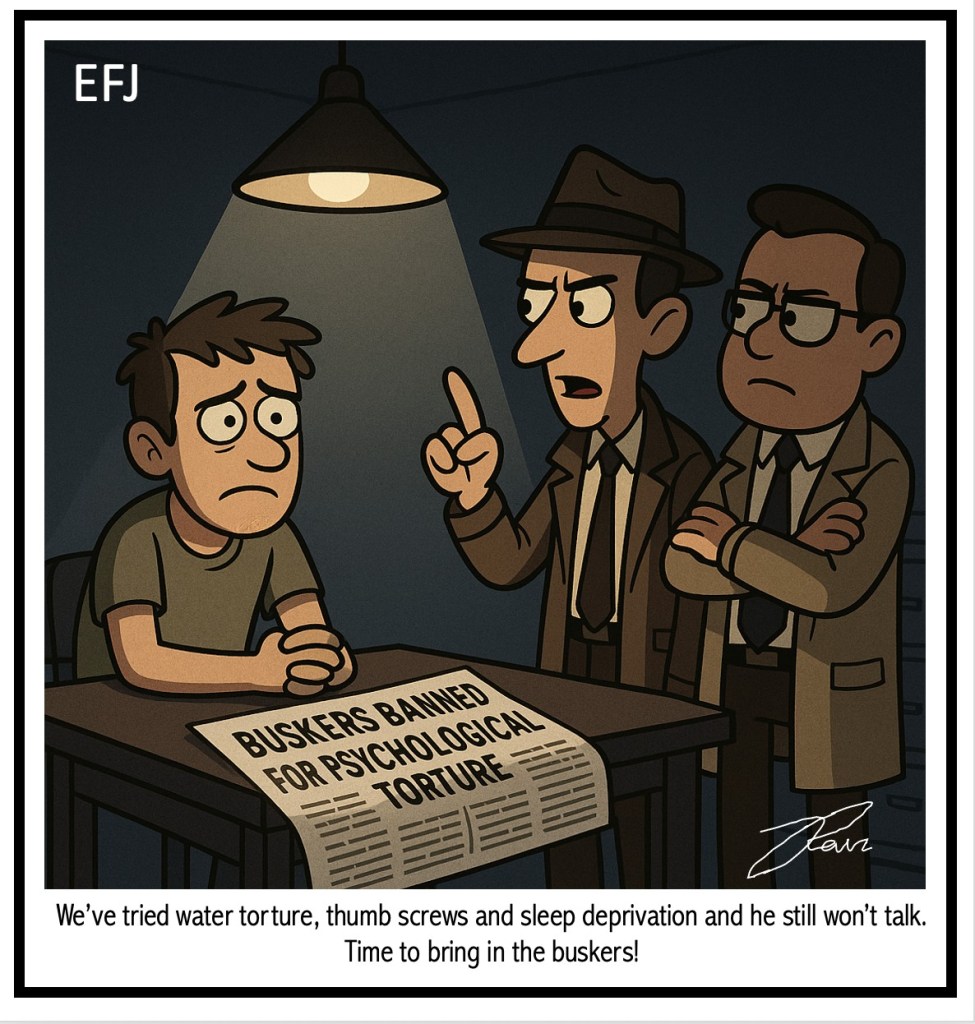
BUSKERS AS PERPETRATORS OF PSYCHOLOGICAL TORTURE ?

A Cartoon by William Hogarth

The violinist glares out through his window at a cacophonous mob who have seemingly invaded the street outside his house; theatrically he attempts to block out the appalling noise by placing his hands over his ears, still grasping in one hand the violin bow with which he was presumably trying to practise before being so rudely disturbed. Yet on the wall of his house we see a poster advertising a performance of the “BEGGARS OPERA”. The irony could not be clearer.

So why do I sense an all too similar stench of hypocrisy – almost three hundred years later – in the torrent of criticism levelled at buskers in Leicester Square by a consortium of music radio stations with offices adjoining the square, who have sued Westminster Council (the relevant local authority) for not sufficiently controlling the noise of these street buskers. ‘Their staff complained of being “plagued“ by poor-quality musicians and said they had to wear headphones, and work from cupboards to escape the sound’ (Evening Standard).

Do I perhaps have a vision of representatives of these same radio stations attending music business jamborees where the supposed “street credibility” of the favoured artists will be celebrated?   And maybe I further suspect that the radio stations themselves will still be broadcasting saturation levels of the limited repertoire of songs (typically forty or thereabouts in any given week, if memory serves) that make up their blanket playlist for the week.   Repetitive indeed.

Furthermore, who could have foreseen how draconian would be the judge’s reaction to, or indeed how timid (one can only suppose) must have been Westminster Council’s defence of, the accusations made by Global Music in pursuit of their aims?  “Repetitive sounds are ‘a well-publicised feature of unlawful but effective psychological torture techniques'”, so pronounced Judge Law in his damning summing up, where he supported Global Music and ordered Westminster Council to put an end to the nuisance.

And does it not seem a strange kind of justice, where there is collective vilification of a group of musicians who were given no chance to answer for themselves?…and where no evidence is presented, or even referred to, of any dissatisfaction with the musicians amongst the public who flock to the Square, listen to the buskers, and patronise the various entertainment establishments there? The term scapegoat comes to mind.

But then why do I worry?    My busking days are over.   It has been many years since I and my colleague Bongo Mike fled to the continent, to avoid daily interruptions to our performances in the West End (and weekly appearances at Bow Street Magistrates Court);  and many years since we returned to these shores – determined to fight our ground – and through our court cases and their attendant publicity, brought about a climate of relaxation for a time, in public places.   

If that time is over – if officials of the state now see fit to describe street music as “psychological torture” (and I do wonder how much personal experience of being subjected to real psychological torture our judge will have had) – then I can only hope there will emerge new champions for our cause, to whom the baton can be entrusted.

Following latest revelations in UK court action, MI5 to adopt new interrogation procedures


And I can only pray that those who would like to see the expansion of busking through co-operation with all manner of local authorities etc. do not get the idea into their heads that they can trade off the free-wheeling, independent nature of our art-form for sponsorship deals and the like. If I may be allowed to quote from an earlier post entitled “An Artistic Disturbance Of The Peace”:

When a busking performance is successful, one of the main features of that success is that the busker is just there. No other form of entertainment achieves this, so far as I know, and in a city such as London, a hothouse of massive plans and ambitions, both collective and individual, it is like a flower that can grow out of concrete. Licensing, and similar attempts at organization, essentially kill off this unique aspect of busking, and like some cheap three card trick substitute for it a new rôle as an underlayer of the regular music and entertainment business.