A Bunch Of Keys

“Every lock that ain’t locked when no-one’s around”

Travelling from one pitch to another, making friends, being offered hospitality in many towns – our lives were ruled by the twin necessities of finding places to perform, and finding places to get a night’s sleep.

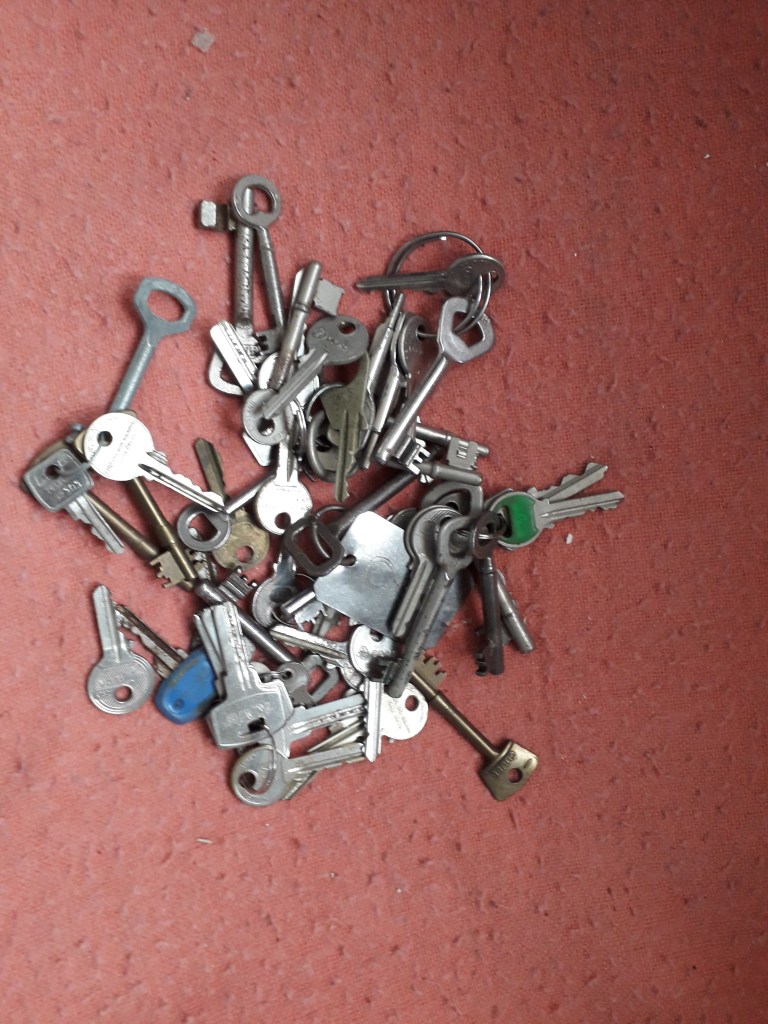
These keys fitted locks of all different addresses in many countries. Some of them unlock doors in the memory too.

Like this one for example – a hotel room-key we accidentally walked off with.

It was 1980 ( I think, though it could have been ’79). We were having our customary late Summer break in the Balkans, and decided that, rather than spend the whole time in Macedonia, we would make a tour round nearby Kosovo – similarly, at that time, a part of the now-disbanded Yugoslavia, being a designated “autonomous region” of Serbia.

We stayed some nights privatno – that is to say, in unofficial lodgings – in Pristina, the main city, and then struck out for Peć (pronounced Petch), a city surrounded by mountains, which we had been told was very beautiful.
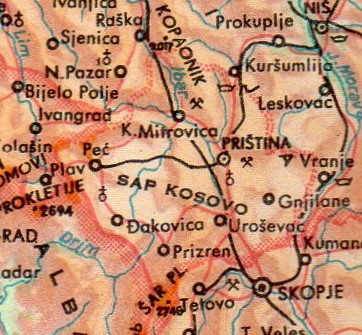
Kosovo and surrounding areas of Macedonia, Albania, Bosnia and Serbia. The thin black lines are railway lines; the thin dark-red lines are main roads connecting large towns; the red-lines with fine cross-hatching attached denote a border between different countries, or between republics within Yugoslavia; the green lines are rivers.

Hitch-hiking was rather slow, and by evening we had still only reached Kosovska Mitrovica, where we broke the journey to get a meal in the self-service restaurant (every town of any size in Yugoslavia boasted a state-owned, low-priced, self-service restaurant) before returning to the road and attempting to resume the journey. Lifts were still not forthcoming, and we got into conversation with a visiting student from Syria who happened to walk past where we were standing, and who offered to put us up for the night in a room he rented from an Albanian family living nearby.

The following day we made it to Peć, which was – as expected – very picturesque, and we settled in for the night at the local campsite, just outside the town, which also had a few rooms. There was a band playing in the evening, Albanian dance music – or “new folk”, as the pop music with a local flavour was generally called. However the band, as was later explained to us, performed some songs which were possibly expressive of Albanian nationalist aspirations, the police appeared, and the fiesta was dispersed.

I want to stress that at this time Mike and I knew nothing of nationalist movements within Yugoslavia – we had not the slightest interest in local Balkan politics, being quite fascinated by the glimpse we were getting of life in a communist society, co-existing as it did in Macedonia (and to some extent in Kosovo) with the remnants of five hundred years of Turkish occupation. Moreover the members of the band, with whom we spent some time after the closing down of the evening’s entertainment, were talking of their interest in the music of Deep Purple and Santana rather than in anti-government sedition. As professional musicians, they had merely been carrying out what is expected of professional musicians the world over, aka playing what the guests ask them to play.

And so onwards the next day, with Prizren as our objective – described to us by all and sundry as an interesting town with many remaining buildings from the Turkish era, although little-known in the west, except perhaps today as the home city – as I have heard – of the family of singer Dua Lipa. Our bad luck with the hitch-hiking persisted, and by the early evening we were happy to accept a lift from the only car that had stopped all day, even though it would take us no further than Đjakovica, a small town halfway to Prizren. The two young men in the car spoke no English and we no Albanian, or – at that time – anything much more than a few words of Macedonian, so conversation was difficult.

Shortly before we arrived in Đjakovica a police car overtook us and signaled to the driver to stop. After a brief conversation with the driver and his friend, the two policemen ordered Mike and me to step out of the vehicle we had been in, beckoned to the young men to move off and to us to get into the police car, and then drove us to a nearby police station. There we were questioned about what we were doing in Yugoslavia, how much money we had etc, our bags were opened and searched, and a sheaf of illustrated poems about street-life in London, written by Mike, seized upon and apparently confiscated.
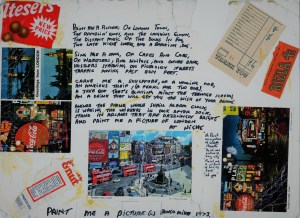
“Paint Me A Picture” an example of the poems which were seized. There are twelve of them – all a little distressed from their travels around Europe in Mike’s bag – together forming a series entitled “Blues On A Windy Day”

We were given the option either to spend the night in the cells, or to leave our passports with the police and spend the night in a hotel. We opted for the latter and walked into the town, somewhat bemused by the turn of events – although, looking back now, it was not so very different from things that were happening closer to home in those days, except that the fear factor maybe increased with the greater cultural distance.

And so we arrived at the Hotel Pastrik, in Đjakovica, recommended – as I remember – by the Police for its reasonable prices. The receptionist understood the situation; after an uneasy night’s sleep we dressed and headed for the Post Office, where we had been informed we could find a long distance-telephone, which we needed in order to put into effect the plan we had formed to call up the British Consulate in Belgrade There was a considerable queue, and as our impatience boiled over we started to get an unusual sensation – for us, at least – of being like visitors from another planet. Some shouting took place.

Eventually we got our phone, and were able to reach the British Consulate, where a typically polite, phlegmatic English person listened to our story and undertook to speak on our behalf to a contact in the Belgrade Police, whom he thought could straighten the matter out for us.

He advised us to call back in about half an hour, and after an anxious wait we spoke to him again. He had – as he had promised – sorted it out; we were to go back to the Police Station, where our passports and Mike’s poems would be returned to us. Whatever the reality, there had clearly been a decision to call the incident a misunderstanding: there were, one could easily suppose, not many foreign travellers of any description who visited Đjakovica, let alone two dangerously long-haired guitar-carrying scruffs like us.

Anyway, thus re-assured we attempted to make our peace with the people around us in the Post Office queue, at whom we had not long ago been exploding in frustration, and then made our way back to the Police Station. We were met at the street entrance by an officer who formally handed us our possessions and gave a kind of salute, for which we thanked him, before going on our way – only to find, once safely en route to Prizren (on a bus this time), that we had made off with our door key from the Hotel Pastrik…….

The poem “Paint Me A Picture” exhibited above, one of those which had excited the Đjakovica police’s suspicions about us, was also (along with the other poems in the series) a song lyric. Some ten years after the events related here, we recorded the song in Skopje, with a Macedonian arranger/kerboardist called Vlatko Kaevski.

The picture here is from Mike’s days as a street poet in London

Ten years later still, we became friends with an Albanian language singer from Skopje called Eroll Jakupi. This below is a video of him performing one of his own songs, QindperQind (or “One Hundred Per Cent”, in English), at a song festival called Polifest, in Pristina in 2003, where he won the gold award for best song that year.

A Thing or Two About Stations

Visiting Paddington Station in 2022, while taking a first ride on the newly-opened Elizabeth Line, I’m reminded of an involvement with this same station (one I hardly use these days) way back in the 1970’s, when I was a new boy in London and spent several years distributing poems – street poems, as we called them – in streets and railway stations, primarily around London, but also in many other towns up and down the country.

This was at the instigation of Mr. Bongo Mike, who was already well-known as the London Street Poet when I met him.(Actually he was the second London Street Poet, the first one having been Street Talking Pete, but he was no longer active at this time.)

So we’re back in 1975, I’ve joined Mike in his literary venture, distributing a few of my poems and some of his, making a precarious but hugely satisfying living at it, and I’m on the concourse of Paddington Station one Sunday afternoon in June, making a sales pitch in the manner first demonstrated to me in Victoria Station by Mike himself, approaching people randomly with some such line as, “Hello, I’m a street poet, would you like a poem to take home with you”, or “…I’d like to give you a poem to put on your wall” (Mike’s favouite), or….well, any one of various other lines you might think of.

Paddington Station as it is today – renewed, but not wholly different from how it was in the 1970’s

Well, I have noticed a uniformed police officer some way off, who I think may be observing me, though I’m not sure. After a few minutes he does approach me, saying “Can you come with me to the office, I want to talk with you”.

I say, “Well, can we not have the conversation here? I mean, if you want me to leave, I’ll just go, no problem” (Or words to that effect. You would technically need a licence to distribute printed matter in a train station, though if you just “got on with it” you were usually ok – but if the police got involved you would have to disappear, and maybe give them a few free poems, depending on their mood!).

He insists that I go with him, so I do, and once inside the office at the edge of the concourse I am verbally assailed by two other officers, who accuse me of being a vagrant, and make various other derogatory remarks. I suppose I might have become a little heated myself, and the eventual result was that I was driven off to Paddington Green Police Station where I was put in a cell for a while, before finally being informed that I was being charged with trespass on the railway, and should appear at Marylebone Magistrates Court the following morning.

My charge sheet. The description of the offence, which is on the reverse of this document, is all but illegible, but does in fact state “That you on Sunday 8th June 1975 at Paddington Railway Station did willfully trespass upon the railway or other works or premises connected therewith and refused to quit upon request made to you by an officer of the Railway. Contrary to Section 16 of the Regulation of Railways Act 1840, as amended by Section 35(1) of the British Railways Act 1965.

When I saw Mike that evening he said “Oh well, maybe it’s a good thing. You’ll find it very character-building fighting a court case. Go to a library and study the law books. You should represent yourself.”

So I did. And because I pleaded Not Guilty, the hearing was postponed at first until the end of July, and then again until the end of September. By chance I ran into an old school friend who had been at Cambridge with me, and was now working at the Home Office, who agreed to come as a character witness; then a former teacher from the same school, and a vicar who lived across the road from where I was squatting, both gave me written character references; and I had a few meetings with a young lawyer who gave me some advice pro bono on procedural matters at court.

In those days, as the accused, you knew only what was written on your charge sheet, i.e. what law you were accused of breaking; you did not know, in advance, what account the arresting officer was going to give, in the courtroom, of what it was that you were doing that caused them to arrest you. I believe this practice has been changed in the meantime, but it meant then that, as the defendant, you had no idea what story the officer was going to tell. (Or as a cynic might put it, what lies he was going to dream up!)

As rebuilt in 2011, and re-styled Westminster Magistrates Court, inorporating the old Bow Sreet, Horseferry Road and Marylebone Magistrates Courts
Marylebone Magistrates Court as it was in 1975

For months I worried and fretted, preparing my case, based on what I remembered of the event; but when the day came the policeman told a story that was indeed – I’m sorry to say – a work of pure fiction. He told the court that he had seen me follow two old ladies around the station and look in their handbags, and that when he spoke to me he had ordered me to leave the station, but I had refused to go.

Now that, looked at rationally, does seem to be an implausible scenario on two counts – not merely because a saint such as I am (!) would simply never do such a thing, but because, even assuming I had, surely the last thing I would then do, upon realizing that a police officer had been watching me, would be to refuse to leave! It makes no sense at all.

But I had – naively, I suppose – been assuming that his story would in general terms resemble the facts as I remembered them, and I had prepared some searching questions to ask, on that basis. As it was, I was completely flabbergasted. I blustered to no real effect for some minutes, but really could think of nothing better to say than to demand to know from the J.P.’s if I was being charged with trespass on the railway or with looking in ladies’ handbags.

The J.P.’s confirmed that the handbags were not included in the charge. And when the time came to give my evidence, I obviously presented the picture of events as I remembered them – much as I have described them above. My character witness confirmed that he had known me at school and at Cambridge, and that he didn’t think it was probable that I would be looking in strange ladies’ handbags in a railway station.

And in my summing up I argued that, if my evidence were to be believed (and really it was the more credible account) then whatever the rights and wrongs of my selling poems on the station concourse, I couldn’t be guilty of trespass because, far from refusing to leave, I had in fact offered to leave, but had been detained at the officer’s insistence.

[The law of trespass – which curiously is only a criminal offence where it happens on railway property – actually describes the forbidden act as “wilful trespass”, which in practice means that you have to have been given a warning, and have then refused to leave, before you can be considered to have broken the law.]

The J.P.’s retired, and on coming back returned the verdict of guilty: there had been a technical trespass, but they would give me an absolute discharge. And the clerk of the court came up to speak to my witness and me afterwards, and informed us – in a friendly sort of way – that he’d been to Oxford.

Which was all sort of pally and alright, in the sense that I didn’t suffer a punishment, and more importantly didn’t have a criminal record, but it did feel like an illogical fudge, and if I had not already been driven mad for four months worrying about the whole thing, I might even have appealed. But it was going to be a difficult business trying to distribute poems at Paddington station in future anyway, even if I did win an appeal. So on balance I decided to just swallow it – which was of course a bit sad, because the street poems had actually been quite popular in Paddington . But there were other stations to try…

….one of these being Kings Cross, where there was both a concourse for the mainline station at street level, and beneath that, at a lower level, a ticket hall for the tube station (both of them suitable locations for my work); meaning that I was to become familiar, over several years, with the layout of the station itself, and with the network of passages connecting the underground ticket hall of the tube station to both the mainline concourse above, and to the street outside and even to the nearby St Pancras Station. And thereby hangs a tale, which I shall leave for another day……

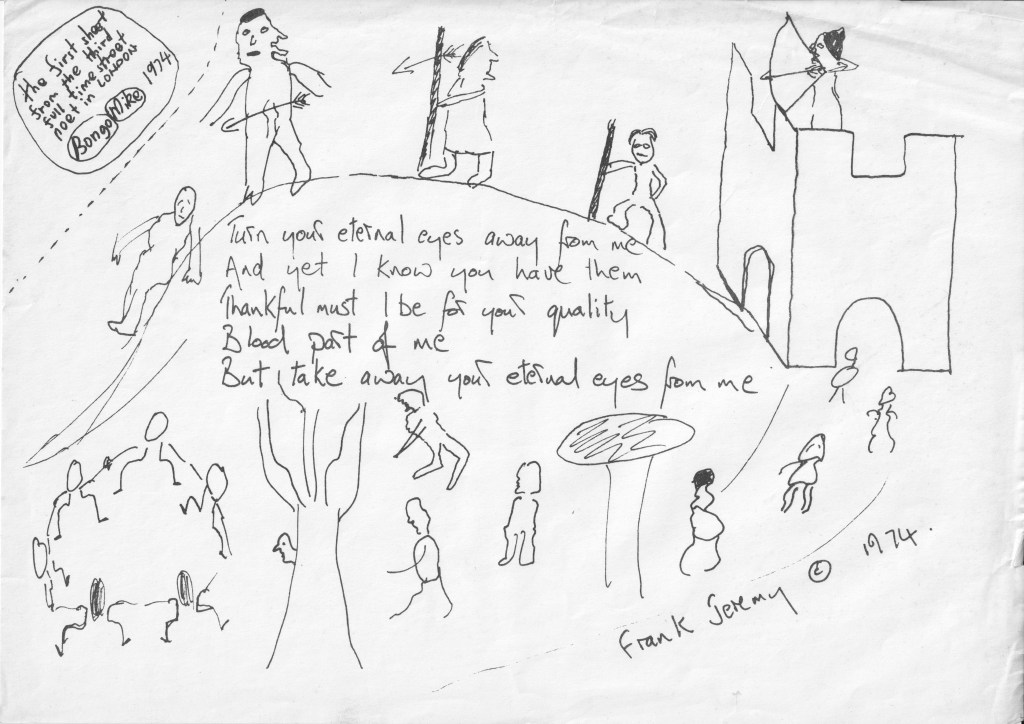
I reproduce here the first street poem I published and sold on the streets, after being encouraged by Bongo Mike to join him, using the artist name Frank Jeremy. And when some time later I took up playing the guitar again, performing as a duo with Mike, I was renamed Extremely Frank Jeremy

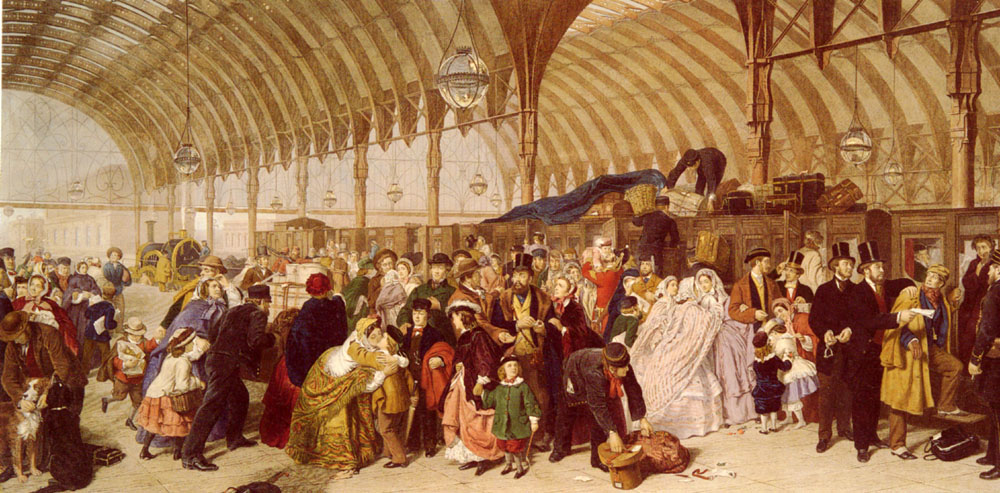
And lastly a picture of Paddington Station, entitled simply “The Railway Station”, completed in 1862 by the British artist William Powell Frith, who specialised in painting crowd scenes of everyday life.

The Railway Station by William Powell Frith 1862 Public Domain

The two gentlemen in top hats on the right of the picture (one carrying what looks like a set of handcuffs) are apparently police detectives, apprehending for unspecified reasons a gentleman who may be having his shoes cleaned – the incident being observed by a station porter on their left. Perhaps the gentleman in question had been trying to sell his poems? (Let’s hope he hadn’t been looking in old ladies’ handbags!)