This being the week – in 2020 – when Mike went into coma and died, I can do little else but try to celebrate his life and achievements.
Michael Kay obituary
(From The Guardian online Aug13th 2020 )
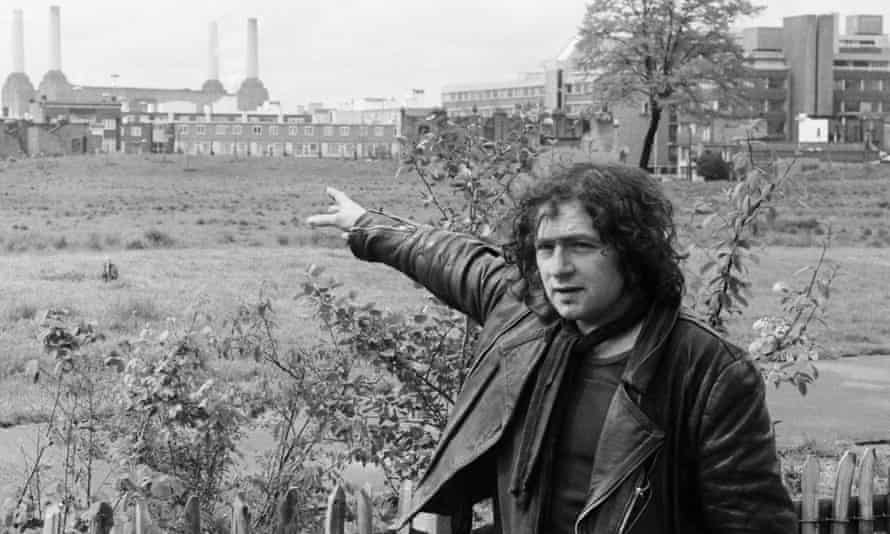
Michael Kay (Bongo Mike) in a promotional image for When The Sun Shines On Wigton, his 1979 exhibition of visual poems. Photograph: Frank Williams
Jeremy HelmThu 13 Aug 2020 17.41 BST
Bongo Mike (Michael Kay), who has died aged 76, was for almost 50 years my close friend and associate, and co-activist in the long-running campaign to get a better deal for buskers – the role in which he became best known to the public.
Born in the East End of London, he spent his early life in Edgware, the adopted son of Joe Kay and his wife, Celia (nee Adler). Joe and Celia were at that time managing a hardware store in Leather Lane, though Joe had earlier been a professional drummer, briefly leading his own dance band.
Michael, introduced to jazz by his father, became a talked-about young drummer on the early 1960s club scene, and a confidant of other young musicians who went on to fame and fortune – though he himself preferred to pursue a more individualistic cultural identity.
In 1972 there appeared on the streets of London and elsewhere a certain Bongo Mike the Street Poet, distributing illustrated broadsheets of his poems for 10 pence each, and further mounting a succession of exhibitions of larger works he called “visual poems” at such venues as Camden Lock and the Art Meeting Place in Covent Garden.
This phenomenon, by the 80s, had mutated into Bongo Mike and Extremely Frank Jeremy (as I was by then known), the militant buskers, fighting through the courts as far as the European court of human rights for better treatment of street musicians. We did not gain any meaningful concessions in Europe, but nevertheless won, in Westminster county court in July 1988, what became known as the Twenty Pence Case (in ironic recognition of the damages we were awarded by the court for a false imprisonment by the British Transport Police).
In the 90s we were joined by other buskers, notably the London Public Entertainers Collective, and Michael was successful in winning support for the cause from the emerging cyberculture, being generously offered by James Stevens of the Backspace Cyberlounge the chance to set up the campaigning website Buskaction. After some two decades of consistent pressure, and the frequent highlighting – through the media – of the busker’s plight, there was achieved the partial, at least, decriminalisation of busking that exists in the UK today.
Retiring from busking in 2010, Michael secured shortly afterwards, with the 33Jazz record label, the release of an album of our own contemporary folk songs, Away from Tube Trains.
Michael was ill for almost a decade with the effects of a stroke and vascular dementia.
He is survived by a half-brother, Ronnie.
One of Bongo Mike’s songs, co-written and co-performed by me. (The website bongomikeandextremelyfrankjeremy.co.uk, referred to in this podcast Suffolk’n’Cool of 2014, is now defunct.)
And to round off this presentation, one of the finest of Mike’s many Visual Poems (as he described this style of work), from the exhibition collectively titled “From A Poet’s Travels”
The material presented on this post is copyright protected
A young gypsy boy in 1980’s Skopje, apparently exercising his right under Yugoslav law to run his own business, provided that he employed no more than ten people (or was it fifteen – I’m afraid I can’t remember).
Photograph by Michael Kay 1986
When I first met, in 1973, the personage known at that time as Bongo Mike the Street Poet, and started working with him selling poems in the street, one of the things I was most impressed by was the fact that he made a living from it, and was thus not existing off hand-outs from a society he self-identified as living outside of – and felt, justifiably therefore, free to criticize it or not, as an artistic decision. I am aware that this could be seen as an over-simplification of complex matters; but there was a straightforwardness about Mike’s point of view, an easily-graspable immediacy which captured my imagination. There have been others I have heard about over the years who have described themselves as street poets, but I am not convinced that the designation had, in every case, the authenticity, or should I call it authority, that it had when Mike used the term – he having paid his dues with a period in his young life of homelessness and virtual destitution, and then having managed to survive from the proceeds of selling his poems to people in the street for the best part of a decade. With Mike you always got “exactly what it said on the tin”.
At the end of the 1970’s and into the 1980’s, as the period of state-sponsorship for experimental/alternative art wilted before a flurry of Thatcherite priorities – market forces, the threat from Russia and the Special Patrol Group, to name a few that come to mind – Bongo Mike and I managed to stay afloat, meeting the challenges of the time by switching from poetry to music, a more easily “marketable” commodity, joining the ranks of the buskers we had worked alongside of for so long. It came to our attention that the street theatre groups and progressive art venues we had been familiar with were getting thinner on the ground, starved of their Arts Council grants. This was not something we were happy about, but still we couldn’t help feeling that our insistence on being always self-sufficient was perhaps more realistic than we had at times been given credit for.
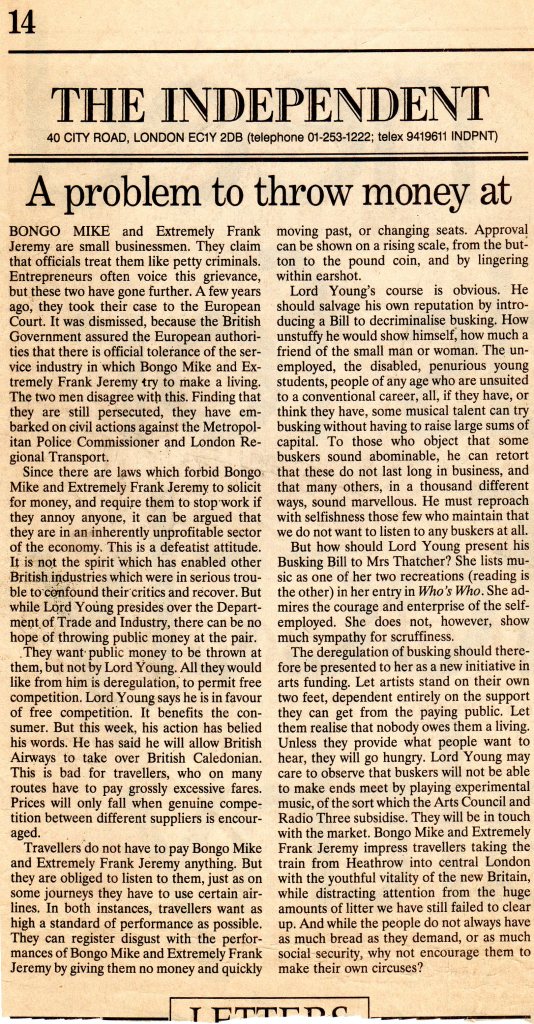
The publicity generated by our campaign for the decriminalisation of busking, which gathered momentum through the 80’s, was to a certain extent underpinned by a perception amongst some in the media that we had found a refreshing way to “stand the Thatcher argument on its head”, as one put it. The Independent chose to make our campaign the subject of a leading article in November 1987 (accompanying a front-page article about us in the same issue), beginning their opinion piece with the startling, and slightly bizarre, assertion: “Bongo Mike and Extremely Frank Jeremy are small businessmen”.
As the 80’s progressed, as western economic strength seemed to be vanquishing the threat from Russia, and academics were confidently welcoming “the end of history” (though it has more recently fought back, one might think), Bongo Mike and myself were frequent visitors to Yugoslavia, and witnessed the slow, painful transition from the communist economic system to the capitalist one, which convulsed the whole of eastern Europe at that time.
A song of ours which encapsulated our farewell to the departing regime was entitled “You Can’t get a Lather On Your Shaving Brush, When There’s Toothpaste On Your Face”.
However, several years further down the line, as the breakaway state of Macedonia – which we were particularly involved with – struggled with some of the contradictions of embracing free market capitalism, we felt a need to update the lyric of our song, which was then re-named “Two Religions”, to reflect (as it seems now) our conversion to the idea of the mixed economy, and in any case to express our decision to disengage our own concerns from the conventional political arena.
Our friends at the train station, seeing us off on our journey
It was 1978. Mike had been in Turkey the previous Autumn, recovering from a bad attack of what he called Tube Train Sickness (more about that in some future post), and where he had – as he informed me on his return – felt the call to visit India at some point in the future. Back in London, in late Winter, it fell to me to inform him that the Street Poetry enterprise – which had been going since 1972 – was fast approaching the end of its life-cycle.
We put our minds to finding some alternative. Mike had always had his musicianship and song-writing (and occasional busking) as a second string to his bow, alongside his poetry; and as for me, I had in my younger days sung and played the guitar in a makeshift group, and indeed even done a bit of summer holiday busking a couple of years running, as a kid…
And so it came to pass, that in the Spring of 1978 a new busking act appeared on the streets of London (see earlier post “The Professor of the University of the Street”); and almost simultaneously, the two buskers in question suffered the loss of their home in London of five years standing, through eviction by the house-owners (the Roman Catholic Church), it having been only a squat.
So with a new job – which could, as began to seem perfectly plausible, be taken with us wherever we might choose to go, and which was, in any case, landing us in trouble with the Police in our native UK; and further, with homelessness now staring us in the face in our native London….well, we did what many a British busker used to do in those days – packed up and took ourselves across to the Continent!
But although considerably less risky in most European locations than it was in Britain, the life of a wandering street musician was not entirely trouble-free over there either. After a month in Belgium playing to cafe terraces in Antwerp and sleeping in a disused old railway station at the edge of town, we caught the attention of a family living nearby our temporary home, and got run in by the local police (squatting strictly forbidden apparently), who advised us that if we signed a statement they had drawn up for us, saying that we had not been able to find accommodation in the local hotels, but were anyway now just on our way to Holland, they would let us go without any further repercussions. (We weren’t on our way to Holland, but don’t tell anybody…)
Or again, in Switzerland (where we were actually going) we arrived in the city of Winterthur, by coincidence at exactly the same time as their local festival, the 3rd Winterthurer Muzikwoche. Local publicity about this had, as we found out later, proclaimed that “the music should be on the streets“. But not ours apparently – after playing successfully to a moderately-sized audience for maybe half an hour, we were whisked off to the local Police Station, fined a percentage of our takings, and informed that the show was over! Though not especially publicity-hungry in those days, we did actually make the acquaintance of a local journalist called Arthur Shappi, who wrote an article about the incident, pointing out the obvious irony of the situation.
Receipt from Winterthur police, and article in Winterthurer Arbeiter Zeitung
By the middle of September we were on our way again, crossing northern Italy without event and arriving in Yugoslavia; and our trip across that country that year, together with our involvement with the Hotel Shar in the city of Skopje, has been described in an earlier post (Song For Bayram).
Leaving Skopje by hitch-hike – our preferred method of travel in those days – we got a lift from a local who was driving to Bitola, a town near the Greek border. He spoke some English (we had not by then absorbed more than a few words of any of the Yugoslavian languages), and upon hearing that we wanted to go to Greece, he said that he would be happy to take us over the border himself, because he wanted to prove to us that there were people living over there who spoke Macedonian! We could not, at such an early stage of our acquaintance with the region, understand why this was so important to him, but anyway from the point of view of our journey it was one step further in the right direction, so who were we to refuse.
Anyway he did have the satisfaction of speaking to some random person in the street in Macedonian – or so it seemed, but I must admit I wasn’t really an expert in Balkan languages in those days – and celebrated the event by treating us to some food in a snack bar before saying goodbye. Thereafter we were, as so often in our nomadic years, left standing by the roadside at the edge of town in the fading early evening light, hoping for another lift before nightfall. We found over the years that Greece was never an easy place to get a lift, but I can no longer remember if on that occasion we got to Thessaloniki that night, or if we had to wait till morning. Nights were quite warm anyway, at that time of year.
Once in Thessaloniki we put up for a couple of nights in a hotel near the railway station called the Hotel Atlantis – which we would have a much fuller involvement with many years later – organized the Cholera jab which was required for entrance to Turkey that year, and set off again, next stop Kavala, a touristic town on the Aegean coast where we did our last bit of cafe-terrace performing for that Summer, and then on again, arriving in Istanbul in the first week of October.
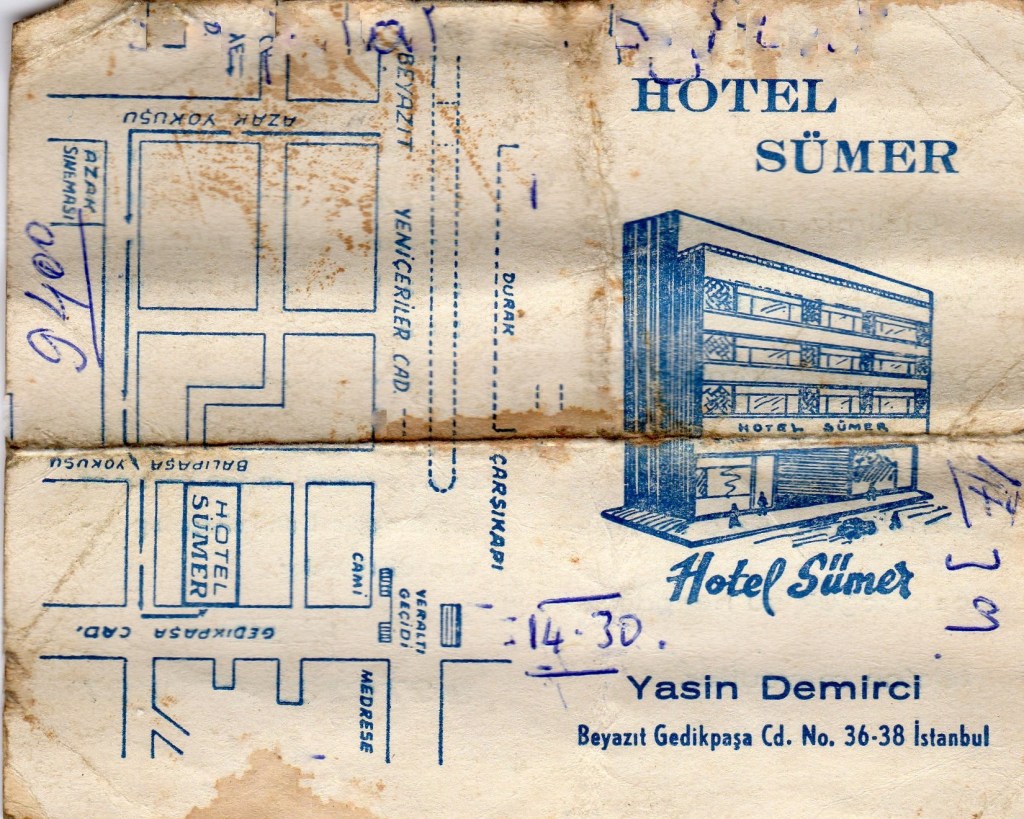
In our travels we would occasionally meet people who, once they had ascertained that we were actually English, would delight in impressing us with their own versions of famous speeches from William Shakespeare et al… One of these was an elderly gentleman who was the principal receptionist at the hotel where we stayed, in Istanbul, this first year of our joint travels – the Hotel Sumer in Gedik Paşa.
Gedik Paşa is an area of the city not far from the famed hippy-haunt of Sultanahmet, and close by the equally well-known Grand Bazaar – or Kapali Çarsi, to give it its Turkish name.
“Aah, ‘To be or not to be – to be, to be true'”, this gentleman would intone each time we passed his desk on entering or leaving the hotel. As we would find again years later with another acquaintance, who inflicted a different but similarly grievous act of sabotage on the same quote – attempts at correction were futile.
“No, ‘To be or not to be, that is the question!'”, we would say with increasing desperation as the days went by. “Yes meester, thank you. Aah, ‘To be or not to be – to be, to be true'” would come the reply.
But the memory from Turkey that has lingered longest, is the music – broadcast continuously on long-distance coaches as you are carried from one city to the next, spilling out from shop doorways, orchestrated or simply sung… an outpouring of the soul of a people, a whole new world of sound to the western ear.
On one early morning walk in the vicinity of the Hotel Sumer, we were making some enquiries in a workshop where there was a printing machine, being operated by a young man who was singing a plaintive song to himself. Long before the days of the ubiquitous mobile phone, we nevertheless had with us a miniature dictaphone, and were able to make the following impromptu recording of voice and accompanying printing press:
Travelling further east from Istanbul we arrived, after a two day coach trip, at the city of Erzurum, in the north east of Turkey, over towards the Iranian border. It was the late afternoon, daylight was fading, and just as we entered an interesting, slightly gloomy-looking waiting-room/cafeteria, attached to the concourse of Erzurum bus station, the lights suddenly went out! Assured as we were by all and sundry that it was only a temporary power failure, nothing to worry about, still we decided – after some ten minutes had passed – to try our luck in the town itself which, sitting not so very far off, could be seen basking in the light denied us at the bus-station!
In the town we soon ran into an office which was a sort of provincial out-post of the tourist industry that had, as it seemed, sprung up to service the needs of the India-by-land devotees who for many years (it was by now already 1978) had been passing across Turkey, en route to those glittering destinations of Kabul and Kathmandu.
Sensing a rather cynical attitude to us, we made our own way through the narrow streets in the twilight, finding eventually an invitingly unpretentious small hotel of the type we always looked for, catering to the nomadic workforce of a still largely pre-industrial economy, and clearly not aimed at the tourist trade.
As the evening wore on, a drama developed around a rather rough-looking countryman who it seemed was not welcome to stay at the hotel – whether because he couldn’t afford a bed for the night, or for some other more obscure reason, we never discovered. He was ejected, and walked away, but some time later returned to the street, and through an open window from the lane outside serenaded those of us inside with a song. He seemed to melt the hearts of the management, and of another guest in particular, because he soon resumed his place in the small room which served as a foyer, and continued his song, alternating his vocal with periodic bursts on an improvised comb-and-tissue-paper instrument – eventually retiring to the room that had been given to him for the night.
The song had a striking and memorable chorus, “Deloy loy, deloy loy..”, which lodged itself somewhere in our heads. A few years later, on another stay in Turkey, we happened to make friends with the owner of a music shop selling cassettes of Turkish popular music, in the night-club area of Istanbul called Beyoğlu. On an impulse Mike chanted “Deloy loy, Deloy loy….”, and asked our new friend if he recognized that snatch of music. “You mean Maden daği!” he said triumphantly, and produced a vinyl single from one of the racks, which he then played for us. It was the same song.
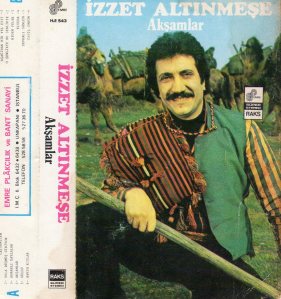
Having only the one disc of that song left, he ran us off a copy of it on a spare cassette we had, but also sold us a cassette of further songs from the same singer, Izzet Altinmeşe
Cassette of traditional songs by Izzet Altinmeşe,, from the same period as his first recording of Maden Daği
Time and wear over the years have rendered these cassettes unplayable, but by a miracle of the modern world, many of the same recordings can be heard today on YouTube – not, sadly, the original folkloric version of Maden Daği, but a much later, more upmarket rendition, sung again by the same Izzet Altinmeşe (albeit a little older now, but still with the same spirit, I think).
Does the coach still drive two days and nights along those partially unmade roads from Istanbul to Erzurum? And does the bus driver’s son still come round with little glasses of Turkish tea for the assembled passengers, at one of the periodic refreshment breaks? Or has that fascinating world disappeared forever? I haven’t been back to find out. I’m not sure I really want to know.
Oh, but since writing this chapter I have somehow managed to restore and digitise the magical original version of Maden daği by Izzet Altinmeşe, which I have posted on YouTube myself and then embedded below:
On my travels in Turkey I acquired a copy of this recording, which I haven’t seen featured on YouTube (though there are other recordings of the same song, by Izzet Altinmese himself, and by other artists), and I wanted to share it, though I don’t own any rights in it. The artwork I have added, which I thought reflected the atmosphere of the music, is taken from a book I have of Turkish folk songs, and is not otherwise related to this particular song, except that you can see the type of wind instrument being played, zurna, and the type of drum, davul. The stringed instrument – saz – which is so prominent on the recording, is absent from this picture, but comes in several different sizes and numbers of strings anyway.
Stop press! I’ve started performing in the street again
(Dear reader, we will transport you back to Turkey in 1978 shortly, but things are happening in London 2021, which are claiming our attention.)
This is me performing by myself outside Earls Court Station.
So where is Bongo Mike? Well I’m recording this in September 2021, and the sad fact is that Bongo Mike passed away in June last year 2020.
It’s taken me this long to get used to it, but you get over these things because you have to. Of course, a friendship and artistic partnership of the best part of fifty years doesn’t just vanish from your mind overnight; but now I’ve started busking again, I’m by myself, and I’ve had to work out a new act. I’m accustomed to having percussion going on with me as I’m playing the guitar, so I arrived at the conclusion that I should now provide it myself with a bass drum and foot-pedal, turning myself for the purpose of street playing into a one man band. Oh by the way, the wheel chair which you might notice folded away in the background is one I got hold of to ferry Mike around in his last few years, and which has come in very handy to cart around the bass drum on buses and trains in London! It’s like a part of Mike is still with me.
When I first came to London in the 70’s there were several one man bands operating in the street. I think it was the success of Don Partridge, who genuinely started his career as a busker and had a couple of hit records in the late 60’s as a one man band, that inspired others in London to try it as well. I knew Scotty and Herman the German, and there were others.
I’ve taken a slightly different approach from these others I’ve just mentioned, in that they all strapped their drum on their back and played guitar while standing, whereas I’m sitting with the drum in front of me – more in the way a drummer would. Don’t suppose it alters the sound much, but it’s a different theatrical effect. And playing music in the street is of course partly theatre.
As you can see below, I’m also starting to perform with harpist Mal Collins, whom I met at “The Grand Gathering”, hosted by Maggie and others in West Wales. . You might call us “One Man Band + One”
And you may have noticed that I’m a fan of Buddy Holly, who performed both these two songs. They seem to work well in the street.
But finally…. this below is another song Mal has joined me on, Singing The Blues. Three singers had hits with it in late 1956/57, Marty Robbins, Guy Mitchell and Tommy Steele – a little before my time, but it was one of the songs Mike liked to play in our early years of busking together, so I made its acquaintance then.
(Full disclosure – the sound of this one was actually recorded in my flat on Mal’s portable Tascam, but we frequently performed this exact version of it in precisely the setting in Portobello market I’ve matched it with here.)
This is the S Bahn in Dusseldorf – a video made by one of the passengers on a train we were playing on, in 1996. We did briefly get a licence to perform on these trains. As you can see they were a great audience, and it was a very enjoyable time we spent there. We did manage to play on the trains in and around London as well. We tried Liverpool and Newcastle, but we lasted about a couple of hours in each before we were stopped by the Transport Police. Glasgow, the only other city in the UK with a metro system, wasn’t possible to even get started in, because there was a security guard in every compartment. I’ve always thought that if the idea were promoted rather than criminalized, it might actually enliven these places. Of course, it’s difficult in the circumstances to do a hugely virtuoso musical performance – I think a touch of comedy works well in these situations. That’s what we used to call it – Situation Art. It’s about knowing the right kind of performance to do in a particular situation
The next step after Erzurum was to be a relatively short coach ride to the town of Dogubayazit – last stop before the Iranian border, lying in the shadow of Mount Ararat….. the legendary landing place, as everyone kept reminding us, of Noah’s ark.
Mount Ararat, as seen from Dogubeyazit Photo:Sabri76
Perhaps fittingly, it was pouring with rain when we arrived; and since we didn’t much like the look of the hotel by the bus station where it was assumed we would want to stay, we were receptive to the suggestion of an Iranian student who had also been on the bus, that we should all three of us share a taxi to the border, which he assured us was not far away. Once across that hurdle we would, apparently, find ourselves immediately in the town of Maku, right next to the frontier on the Iranian side, where we would definitely find a better hotel to stay in than the one we had been shown in Dogubayazit .
Our student friend’s information was not the most accurate: Dogubayazit was still thirty kilometers from the border; the Turkish border was already closed for the night; and Maku was another thirty kilometers from the Iranian border on the other side – but we are racing ahead of ourselves.
Stepping out of the taxi into the pouring rain, we looked around and saw the border post nearby, but it immediately appeared that there was something wrong. Our student walked over to what seemed to be the office – there was a short conversation – after which he returned to us with the news that because of the trouble in Iran, the Turkish border was these days closed from early evening till the following morning.
BORDER CONTROL
Trouble in Iran! Yes, as far back as Istanbul we had been hearing stories about an Iranian cleric who was living in exile in Paris, and who was the figurehead of a growing protest movement within Iran against the rule of the Shah. But, preoccupied as we were with our own grievances concerning the plight Europe-wide of street culture in general, and street musicians in particular, we had not been paying much attention to the newspapers, as they frequently seemed to be just another arm of the force that oppressed us anyway.
We found a derelict building which offered partial shelter from the rain, had a slight grumble at the Iranian student, and settled down to an uncomfortable night’s wait.
Suddenly two large Range-Rovers with Teheran number plates arrived out of nowhere, the driver of one of them greeted us in American-English, and we told him the border was closed. “We’ll see about that”, he said, marching over to the office. He knocked loudly on the door, produced a 100 Deutschmark note from his pocket, and waved it slowly backwards and forwards across the window pane. The response was electric. The light in the office went on, we saw the guard straightening his cap, jumping to attention, opening the window and having a quiet word with his important visitor – who then walked back to us: “OK guys, it’s all fixed. 50 Deutschmarks each, and we can all go through.”
Mike and I were not so impressed with this deal as was the Iranian student, who immediately jumped in with one of the drivers. But as for us, with no clear idea of how we would be earning any further money for the foreseeable future (street busking in India and other countries of the sub-continent not having been recommended to us as a very profitable activity) … well, frankly, 100 Deutschmarks between the two of us looked like quite a high price to pay simply to cross a border a few hours earlier than otherwise we would anyway. We therefore declined the offer. The Range Rovers roared off with the Iranian student, and we settled back into our temporary shelter.
After about 5 minutes the Turkish border guard walked over to us. “Sen Turist?” (Are you a tourist?), he addressed me . “Tamam” (Yes) I replied. “Gitmek. Parasiz” (Go. No money) he announced, and motioned us across the border.
We had left Europe behind.
CANDYMAN
We walked slowly across the hundred yards or so that divided the two borders. On the Iranian side the lights were all on, and two guards stood waiting to question these two strange-looking travellers, carrying a large bag, a guitar and a set of bongo drums between them, who had managed to filter across from Turkey despite the border being closed.
“Aah, British”, they said on examining the passports, as if that explained everything. “Where are you going?” “We’re going to find a hotel in the town here”, we replied. “The next town is thirty kilometers away, over that hill”, said one of them, pointing in the distance. “First bus in the morning.”
We stood where we were, running out of ideas for managing the ever-deteriorating situation. “What is this?”, one of them asked, pointing at the guitar. I told him. “So you are musicians. Maybe you can sleep here, if you play us some songs.”
Opening song from our first album “Exile in Balkan”
Taken into the office, we were shown where we would sleep…underneath the desk of an official who would not appear until the morning. We then took out our instruments, to satisfy our side of the bargain, and would have started off with – I feel certain, though my memory does fail me – our version of “Candyman”, one of those songs any self-respecting folky could reel off in those days, maybe followed by Mike’s song “Kilburn Station”, and probably rounded off with our perennial favourite “It’s a Crime to Play Music in the Streets”…
And so we slept peacefully, under the above-mentioned desk, but suffered a rude awakening early in the morning – a kick up the backside announcing the arrival of the desk’s daytime incumbent. We walked out in the drizzle, and stuck our thumbs out once again.
Standing by the roadside in the early morning, a short distance from the Turkey/Iran border post, attempting to avoid the intermittent rain which had followed us across the border, we were joined after some time by an Israeli hitchhiker who had just crossed from Turkey, following the opening of the border in the morning. (The border being closed at night, as I said above. ) After what seemed like a long wait, a German VW camper pulled up and offered us all a lift to Tehran.
The van unfortunately broke down just after the first town, and the friendly couple driving decided reluctantly to abandon their journey – although the journey we then had to Tehran, as a result, was probably the more eventful for that.
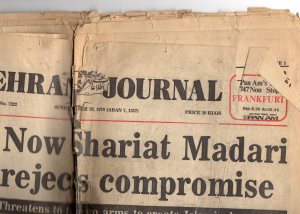
English language newspaper from late October 1978
While trying to get a lift further on from that very same spot where we had been dropped, we soon attracted a largish crowd of young children who would shriek with delight and immediately surround any car that was brave enough to stop for us, whereupon the driver would race off again before we could even speak to them. Eventually one stopped with two young men in it who seemed to be made of sterner stuff, because they ordered the children away and waited for us to come to the window, and did indeed pick us up.
They were soldiers, going on holiday to the Caspian Sea, who spoke quite good English, which was lucky, because Mike and I had nothing to offer but a smattering of Turkish. They took us to Tabriz, the first big city on our route – and the centre, apparently, of the Persian carpet business – where they bought us dinner and paid for us to stay the night at a local hotel. Such kindness from complete strangers has often been a feature of our lives as wandering musicians.
And then on the other side of the coin – a little further down the road we got a lift from two men describing themselves as businessmen. A friendly enough rapport seemed to have developed, but things took a turn for the worse when we got out. Attempting to retrieve our bags and instruments from the boot where they had been stowed, we found the boot-lid difficult to open, and were met by a series of gestures from the chaps, who were saying what sounded like “pull”.
As the lid still refused to open, it slowly dawned on us that it was in fact locked, and that our erstwhile friends were demanding money from us to open it! Their devilish scheme was however thwarted by a taxi driver parked nearby, who noticed what was going on and made some threat which resulted in them opening the boot-lid and giving us back our bags in a hurry! (Many years later, having frequently puzzled over the matter, I made the discovery that what they must actuallyhave been saying was “pul”, an Azerbajani word meaning “money”.)
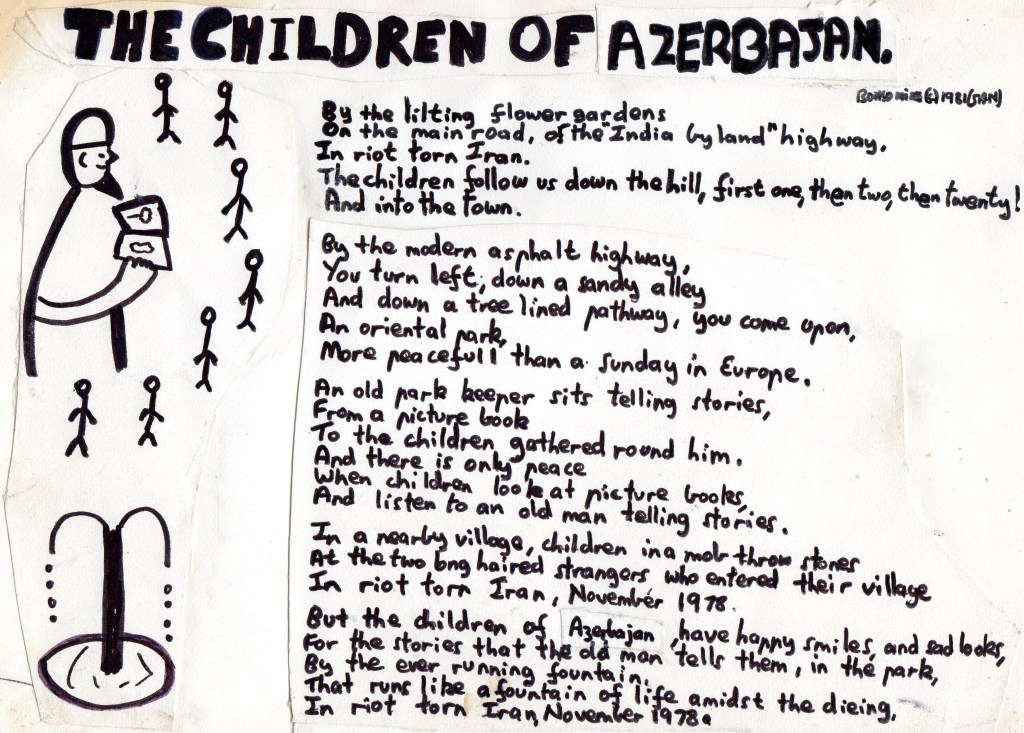
A poem by Bongo Mike, written in the Street Poetry style, but never published
Then there was the meeting with an enthusiastic young boy in one village situated en route, who introduced himself thus, “Heart, I am Iran. Mother Turkish. Understand English!”, and then proceeded to show us round the village. As we walked down a narrow path, carrying our instruments, we came to what our friend told us was a school; and as we walked by, another boy came running out of the school, saying to our friend that the teachers, who had apparently observed us on the pathway, wanted to know where we were from, and if we would play some music for the children.
We agreed, and as we walked through the school gate into the playground the children came bursting out of their classrooms, milling – or rather swarming – round, before settling down into a large circle around us on benches which the teachers brought out, listening with rapt attention to our song “I am the Professor of the University of the Street”, and some few others. When we were finished the teachers spoke for some time with us, and gave us some money. (Our second impromptu gig then, following our brief concert earlier at the border post.)
Our young guide in fact spoke rather little English, but we understood him, even if more by the context than the words he used; a couple of times, for example, politely holding a door open for us to walk through, he would say, “Please Mister, take my seat”. He took us to a park where an old man was sitting by a pond, reading a story to some small children. As we left the park some other children in the distance, larger and rather aggressive, threw stones at us: “from next village”, he told us. “You must taking bus; you must going to the Tehran”, he added, “boys village, fifteen hundred good, fifteen hundred bad”.
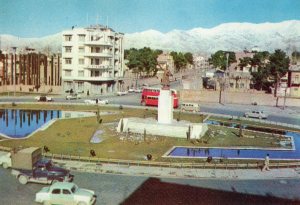
A postcard from my father, from Tehran in the 1960’s. He was abroad much of the year with his work, which took him to many of the same places that I later visited as a wandering street musician
We took his advice, and arrived in a Tehran which seemed relatively peaceful, if a little tense. The most memorable first impression was the double-decker Leyland buses, which seemed to have been exported from UK minus the safety warning about no standing-passengers on the upper deck! An attempt at busking in a park in the centre of town drew a large crowd round us, which was then dispersed by truncheon-wielding police, who contented themselves with kicking our guitar case when they saw that the centre of attraction was only two hippies playing some music. (The more things change, the more they stay the same… we really felt quite at home!)
An artisan at work in Isfahan in a more peaceful time
News about the political situation did of course filter through to us, and our initial reaction, after a week or two of familiarizing ourselves with the city, was to proceed through to Pakistan before things got too hot! We took a coach to Isfahan, but the atmosphere in that city, beautiful though it would clearly have been in other circumstances, was very disturbing. We felt vulnerable walking round the streets with our instruments and bags, not understanding the language and sensing hostility to strangers, and felt greatly relieved when a young man approached us and asked if we were looking for a hotel. Answering in the affirmative, we followed him and found ourselves in the Mihan Tour Inn, a small hotel run by a bus company of the same name – Mihan Tours.
We got a safe bed for the night, and a chance to weigh up the pro’s and con’s of our situation.
If we carried on our journey now, we might well get through to safety; the route, as people told us, was straightforward by coach – Kerman, Zahedan, Pakistan.
But there was a distinct possibility that the return journey by land would be anything but straightforward, given the signs of civil unrest we had already witnessed. And we didn’t have the resources – as others might – simply to take a plane back to London from wherever we ended up.
We weren’t, after all, sponsored adventurers, but travelling musicians who had got caught up, rather late in the day, in the “India by land” trip; and furthermore, we had our own dispute with authority – in the UK and to a lesser extent in much of western Europe – which we were arguably running away from by immersing ourselves in the fashionable, collective adventure of the times.
So in the end there was only one sensible decision we could make….. Back to Tehran. With Mihan Tours. And then back to our own war in the West.
The song “Goodbye Winepress Street”, though not of course about Iran, does perhaps reflect the same spirit as that in which we made our exit from Iran back in 1978 – being a statement of our feeling that as artists there was no real satisfaction in following any pursuit but that of our own artistic calling.
It all began with moving some furniture in our flat in London, in April 2002. We’d spent the day moving stuff to the centre of the rooms, so that builders could install double-glazing for the windows and some radiators for the new central heating, and then we’d camped out in the sitting room to get some sleep. But disaster was waiting to strike.
Getting up energetically the next morning, from a makeshift bed on the sitting room floor, Mike slipped a disc. And then sadly there could be no more Bongo Mike for a couple of months.
THE SINGING PASSENGER
But you will be familiar with how necessity is often credited with being the mother of invention? Our chief vocalist and percussionist could not perform on bongos on the train, because the getting up and down continually from his stool, not to mention the bodily movements involved in playing the bongos themselves, were too painful….well, ok, but he could still sing couldn’t he?
There ensued a trial run through of “If you can’t have a shave….”(albeit in our kitchen this time)
Yes, it seemed he could still sing.
And so was born “The Singing Passenger” – as we called the act that we went on to perform for some two months, while Mike recovered from his injury. We appeared in our usual locations – although tube trains seemed to work better than the suburban mainline trains – but minus the bongos.
BOOKED
Despite our initial reservations it was quite successful. Artistically, at least. Our volume was lower, and frequently insufficient to reach much of the carriage, given this rather noisy setting we were accustomed to performing in; but the effect on those in our immediate vicinity was electric. Dressed for the occasion in white shirt and bow-tie, maybe hanging onto an overhead strap, and not obviously connected with me standing nearby, Michael would suddenly burst into song, as I hoisted up my guitar and launched into our introductory rendition of “This Train”.
And so it was that, after a couple of weeks of this, two or three members of a rock group with their manager heard us singing, in the train carriage they were travelling on, and gave us a phone number to ring re: playing as a support act at a concert they would be giving a couple of months later, at the Astoria Theatre in London.
Not the type of booking we usually got, as our solicitor friend pointed out!
At the top is a film of our section of the concert, as provided to us by the management of the group My Vitriol.
LATER
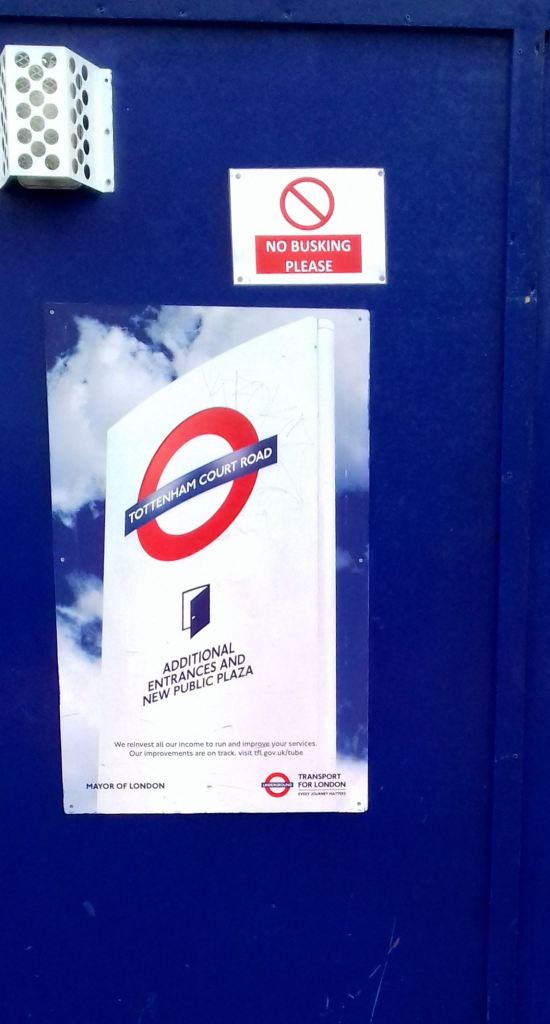
And after a certain interval, in December 2016, as works were in progress to demolish the Astoria theatre to make way for alterations to Tottenham Court Road tube station, a telling sign appeared on the hoarding by the side of the road. It struck me as a possibility that some Westminster bureaucrat was thinking they’d really scored a triple whammy this time: no busking on trains since London Underground had brought in the limited licensing scheme at some tube stations; no busking now in the street outside the Astoria; and in case one were getting any big ideas, no more Astoria either!
But knocking down stone walls does not kill an idea…. as William Blake might have said.
Well, after skirting round the issue for a considerable period of time, with many stories about what happened to Mike and me as we practised the form of art which seemed to get us into arguments and trouble the world over, I’m now going to try to explain what we meant by the term “Situation Art”, and why we were so attached to it. When I have had my say, you might still respond (as a one-man-band of our acquaintance once did) with the immortal words of our title above. But I hope not.
I shall take the argument through the following steps: a brief history of the involvement Mike and I had with the traditional culture of broadsheets and busking; a contemporary analysis that we arrived at of what we were doing, introducing the idea of Situation Art; a look at the problem of the non-recognition of Situation Art as a “self-standing” category, and the misunderstandings this causes; further definition of Situation Art, by comparison with a classical music performance and a theatrical performance; and a brief study of the meaning and value of Situation Art in today’s cultural context, along with some consideration of official attitudes to it.
But first a word of caution; the problem today is that there has been a partial acceptance, not to say adoption, of the style – everything’s “street” this and “site specific” that and “accessible” the other, and “pop-up” yet another — and you find yourself saying, wait a minute, we were doing all that way back, before there were any prizes given for it….. in the days when the best you could hope for was a free ride to the Police Station in a Black Maria!
So I’m handling today’s post with care – over the course of a lifetime a lot of things change their shape. You have to be careful that you’re not just continuing with yesterday’s battles after they’ve ceased to be relevant, and yes, sometimes you have to know when to back down. But I think it’s also good that someone keeps an eye on whether real progress is being made in relations between artists and authorities, despite the apparent blooming of interest in public place art.
STREET POETRY
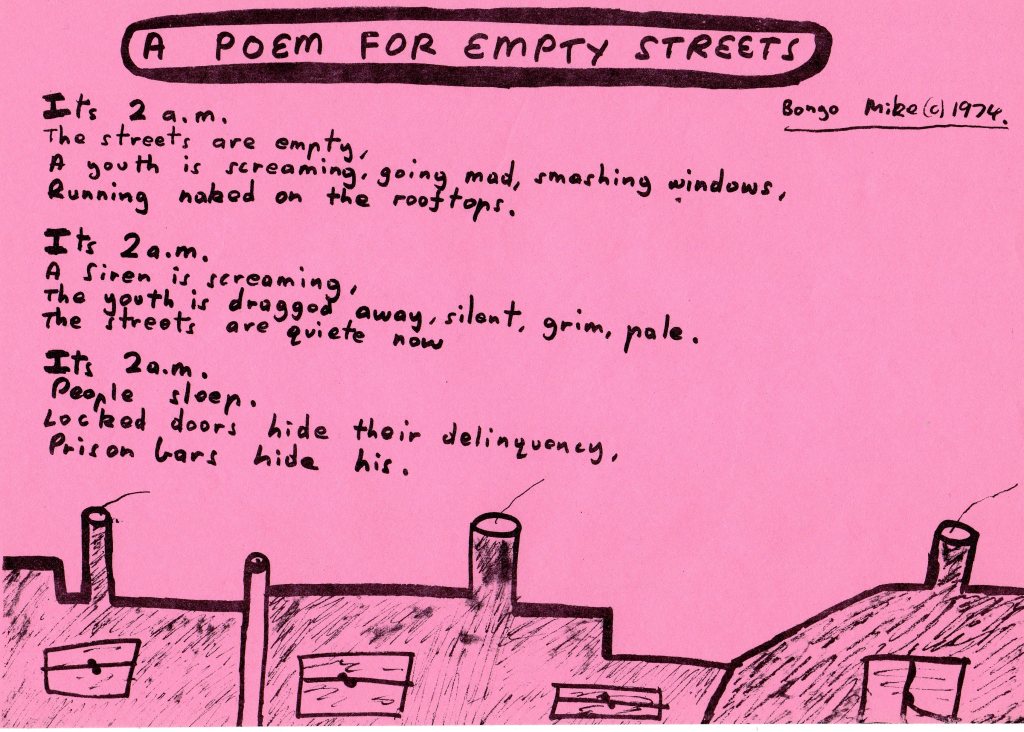
A Street Poem – one of about 70 distributed by Mike and me in London and certain other towns around England and Wales from 1972 till 1978.
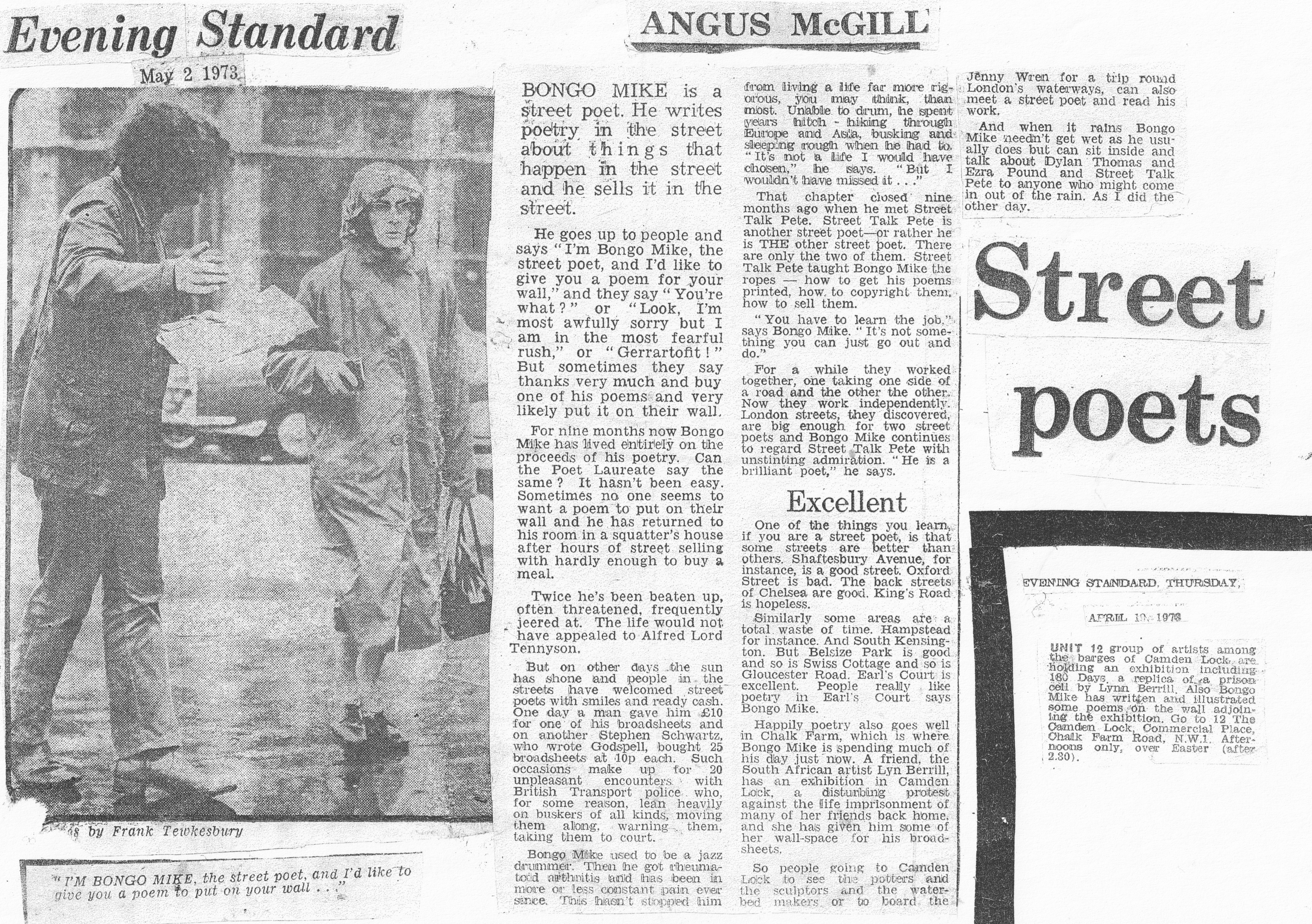
Consider poetry, for example. It sometimes looks as if any poet these days who isn’t published by Faber and Faber can call themselves a street poet. But what does that actually mean, indeed does it really have a meaning at all? I’ve reproduced below an article from the London Evening Standard of May 1973, called – funnily enough – “Street Poets”, which is mainly about Bongo Mike, and which I think gives quite a reasonable account of what you might expect the life of somebody calling themselves a street poet to be like. As the journalist Angus McGill wryly comments, “the life would not have appealed to Alfred Lord Tennyson”.
Now, there was a performance element to our street poetry (I say our, because I joined Mike out in the street, from Spring 1974 until we wound the operation down four years later) – or perhaps it could better be described as an interactive element. Anyway, if we take a close look at a few memorable lines from the celebrated poem “The Waste Land”, by T.S. Eliot:
Unreal City,
Under the brown fog of a winter dawn,
A crowd flowed over London Bridge, so many,
I had not thought death had undone so many.
Sighs, short and infrequent, were exhaled,
And each man fixed his eyes before his feet.…
(from The Waste Land, Part I. The Burial of the Dead)
we can then consider that some fifty years after this was published, street poets were entering the scenario, distributing poems (or at least attempting this feat) to those apparently undone by death.
STREET MUSIC
Towards the end of the 1970’s we decided that living solely from poetry was getting tough: inflation similar to today’s was making it difficult to set a realistic-sounding price on the sheets we were offering the public, and it was starting to seem like a misfiring idealistic venture rather than a joyous celebration. Though it must be said that in general – albeit not everywhere – we had been free from interference or harassment by police etc.
As street poets, operating frequently in London’s West End, we were of course acquainted with the characterful collection of buskers who were also around: Ronnie Ross and his Sand Dance, Don Partridge and his associate Alan Young, Scotty, Herman the German, the Earl of Mustard (otherwise known as Jumping Jack), Old Meg Allan, and Paris Nat Schaeffer (whom sadly I never met, on account of his early death, but still heard all about from Mike and others)… It was an inspiring bunch of people. And with encouragement particularly from Ronnie Ross, we set out to develop our own individual musical act, as what we hoped would become an alternative to – if not a huge step from – poetry as a mode of income.
Street music, or public place music might be a better way of putting it, happens in a large-ish variety of situations. After a couple of false starts, we found our first success in Green Park Underground Station, by the side of the passageway joining the Piccadilly Line and the Victoria Line, at Easter 1978. The song which resonated with the passers-by was one of Mike’s compositions “Kilburn Station”, a slow moody song which sounded perfect in the subway. (We’ve since recorded a version of it with a slightly expanded musical arrangement.) But from what I remember, we saw little chance of earning a living, performing in an environment replete with “No busking” signs on the walls, and where, away from Easter, many other players would be jockeying for a pitch.
Our next success was on the street outside Earls Court Underground Station in the early evening, featuring a song called “Midnight Special”. Unfortunately we didn’t last long there – after a few days the friendly local police put a stop to the party.
On the third attempt, we found a pitch we could call our own – Coventry Street, in the evening, outside what was then known as “Bernard Delfont’s London Experience”. A song we wrote there had a peculiar origin: it was a quiet night, not many people out, and we were in a creative sort of mood; I was playing a repetitive riff on the guitar, and Mike was starting to sing extracts from one or two of his poems, to the rhythm. Suddenly two police officers walked up to us and – as usual – ordered us to stop playing. We packed up and went home in disgust, but the following day one of us said “Well if that’s what they want, that’s what they can have!” – we picked up the rhythm again, but in place of the planned mellow poetic lyric, we put a court case where a musician is arrested and tried in a Magistrates Court, and found guilty of busking. (I have described the scenario, including a later electric version of the song, in an earlier post The Professor of theUniversity of the Street.)
This, together with other edgy songs we composed or adapted while playing there (“It’s A Crime to Play Music in the Streets”, “Family of Freaks and Schizophrenics” and “I Just Wanna Live My Life” come to mind), fitted very well the context in the West End; and if it weren’t for the fact that we were spending more time in Bow Street than Coventry Street, we might have continued there for many years, instead of heading off for a nomadic life on the Continent, where we became café and terrace players, delved into Mike’s jazz heritage to develop our “Spasm Band” act – and acquired the freedom of approach to take on playing on moving trains and trams, something which we then brought back to London, on occasional visits “home”.
SITUATION ART
But in every country we went to, whether the act of performing in a public place were illegal, semi-legal or broadly tolerated, we found that street musicians were exploited and relatively down-trodden. This is not to say that we were treated uniformly badly- there were great times, and golden memories. But we were always conscious of something missing. Artistic acceptance. We had come off the pedestal of poetry, don’t forget, in our attempt to find a better way to relate to the public place audience; we had developed a populist act, built around original musical material; but we were not taken seriously, by comparison with either classical artists or pop artists.
Then one day in early 1981 we had our “lightbulb moment”, as described in the first post I published on this site, Welcome , when we saw that there was a specific artistic identity that ran through all the different types of performance we did in all the different towns we visited (including street poetry in London, as we realized at this point) – and Mike gave it the name Situation Art.
As we developed this idea of Situation Art, we realized that it represented an artistic perspective in its own right, quite separate from the conventional skills (be that musical proficiency, quality of voice, excellence of repertoire etc.) exhibited by the performer. It had to do with the relevance and appropriateness of the performance to the situation – and thereby brought the situation, with all its diverse possibilities, into the equation. And it seemed to us, that it was only by an idea of this sort being accepted, at an intellectual level, that buskers would ever be recognized as artists in their own right, and so be elevated above the degraded level at which they were generally valued in the days when we were active – e.g. as some kind of traditional “folk hero”, or maybe as a music student getting some practice while studying, rather than a particular type of performer, doing something with its own timeless validity.
Musical buskers tend to get judged by so-called experts on the basis of how good a musician the expert considers them to be. Yet some of the most memorable buskers might be hardly musicians at all, in the conventional sense. For example “Coneman” (as he was affectionately christened), who would somehow acquire a traffic cone, and by blowing through a hole in the top of the cone would turn it into a kind of wind instrument with its own distinctive sound; or Victoria the Comb Lady (see below), a Dixie-style soloist who played her comb with us a few times outside Brixton Station where she was generally to be found.
Comb, kazoo, guitar, bongos, voice in Brixton
And it is widely held to be part of the history of Jazz, that street bands in New Orleans, known as Spasm Bands, playing music of uncertain origin on homemade instruments, as the 19th century morphed into the 20th, were one of the founding pillars of the new culture. Early critics of jazz were not especially impressed, and could find quite negative things to say about it, e.g. “It is not music at all. It is merely an irritation of the nerves of hearing..” – this from a Professor Henry van Dyke of Princeton University. Of course, Jazz later became much more accepted, but as the intellectual heavyweights moved in, the Situation Art aspect of its early days was almost entirely phased out of the picture. (See Herbert Asbury, “The French Quarter” and Robert Goffin, “Jazz: from Congo to Swing”.)
That is not to say that Situation Art theory necessitates a conflict with conventionally proficient performance – of classical music, for example. But we only have to look at the experiment carried out by the famous American violinist Joshua Bell, as reported in the Washington Post article Pearls Before Breakfast, to see that a virtuoso performance of some of the greatest pieces of music from the western tradition doesn’t necessarily work in every location at any old time of day.
Art which requires such a degree of worship, it seems, needs a suitable temple; but places need to be respected too; a player dressed as a clown doing a simple bit of juggling might have been more in keeping with that draughty passageway than Mr. Bell. And further, what sensible busker would choose the early morning rush-hour? !
ALL THE WORLD’S A STAGE
In a foretaste of today’s discussion, I quoted – in an earlier post – from a book written by Peter Brook called “The Empty Space”:
“I can take an empty space and call it a bare stage. A man walks across this empty space whilst someone else is watching him, and this is all that is needed for an act of theatre to be engaged.”
I mention this because I came across it after many years of being fascinated by the experience of sitting on the westbound District Line platform on the London Underground, at Victoria or Embankment Station, watching the eastbound platform slowly fill up with passengers after being emptied by the departure of a train. Like in a conventional theatre, some actors appeared from a staircase at the back, others from what seemed like the wings, at the side; and of course some were static on the platform already, the departing train not having been theirs.
Snatches of conversation might waft across, though a little indistinct, but one could exercise some imagination.
So… a conventional playwright might be inspired by the scene depicted above, and go away and write a play about it. A situation artist would be more likely to get on the next train with them and sing a song – or indeed recite a poem. (See picture below.) More interactive, more direct… But I’m not saying that the world should have either one or the other. I’m just making a case for what I’ve spent my life doing.
And, it being a quite different kind of thing from conventional, organized artistic events in which London abounds, it requires a different skill-set…Situation Art, as I have been calling it.
BEAUTY IN PUBLIC PLACES – AN ARTISTIC DISTURBANCE OF THE PEACE
I’m turning now to an article called “Discover: A Beauty of Situation, Provisional and Lived”, which appeared in a Belgian online progressive arts magazine called Archipelago, in 2012. The writer talks about various aspects of what he calls “beauty in public places”. He considers, among other things, the work of myself and Bongo Mike, taking ideas expressed by us online over the years, and putting them in a broad art-philosophical context. The whole article is interesting, but I’m only going to quote here what is immediately relevant to my drift. (It has here been translated from the French,)
He talks about what he calls simple scenarios from everyday life, or what we would call “social situations” – eating places, markets etc. – and continues:
“strolling players” and other street artists may make interventions “in situ”, motivated by the possibility of a renewed connection with an audience, in a relationship of proximity made impossible by the usage – now normalised – of the “stage” space, to mark a distance or boundary separating the audience from an inaccessible idol.
This contextual dimension forms the basis of the practice of busking. The busker starts by looking for a spot which is appropriate for his musical intervention. The attention is therefore focused on the environment and the relationship which may be created with the audience. The buskers or street musicians therefore develop an art of attitude and of performance rather than a specific sound.…
They are often driven away and even persecuted, running the risk of prosecution, of violence from the authorities (or the public),of fines and penalties of imprisonment…Bongo Mike and Extremely Frank Jeremy… these two singular figures, whose life of discomfort on the road has led them from London to the Balkans, through Belgium, have defined their practice as “situation art”, which one could be tempted to translate as “art de la situation”.
How does one react when facing a situation? What is the difference between an ordinary situation and an aesthetic situation? If the event is recognized from the word go, as belonging to the world of art (taken in its largest sense), it will induce behaviours, which will depend on that recognition (rejection, incomprehension, contempt or conversely, fun investigation of an ‘artefactual’ situation or even an intellectualisation on the part of an informed and initiated audience.) If the event fades into the movement of the world, so that it participates in it without too much exhibition, one could believe that the reactions, less conditioned, will be more spontaneous, freer (without interference), although without being completely unconditioned (external factors always remain, as well as biological, socio-cultural and psychological causes; the eating places, the market and street animation remain coded activities one way or another).
So he’s talking here in the last paragraph about our kind of minimalism, that blends the artistic event into “the movement of the world”, as a way of eliciting a more spontaneous, unconditioned response (which does hark back to Peter Brooke’s idea of theatre as a relationship rather than a building).
PRACTICALITIES
Bongo Mike and I had started to think that “on-train busking” (as the official world would refer to it), being the most controversial thing we did but also the most rewarding in terms of audience reaction/participation, was probably the best demonstration we could give of what we meant by our ideas – and the official response to it maybe the best gauge of how genuinely accepted was the whole artistic phenomenon. But sadly you can’t please everyone – or at least, not all the time. And despite our view of what we were offering – the element of joyful surprise, of just being there, and maybe, out of the resulting confusion of expectations, the facilitating of “a brief parting of the curtains that keep the light of immortality out of the chamber of everyday life” (as the earnest advocate, that I used to be, did once describe it)….despite all this, as I say, our performances on trains were the one thing that has never been on the table in any discussion about better treatment for buskers in the UK.
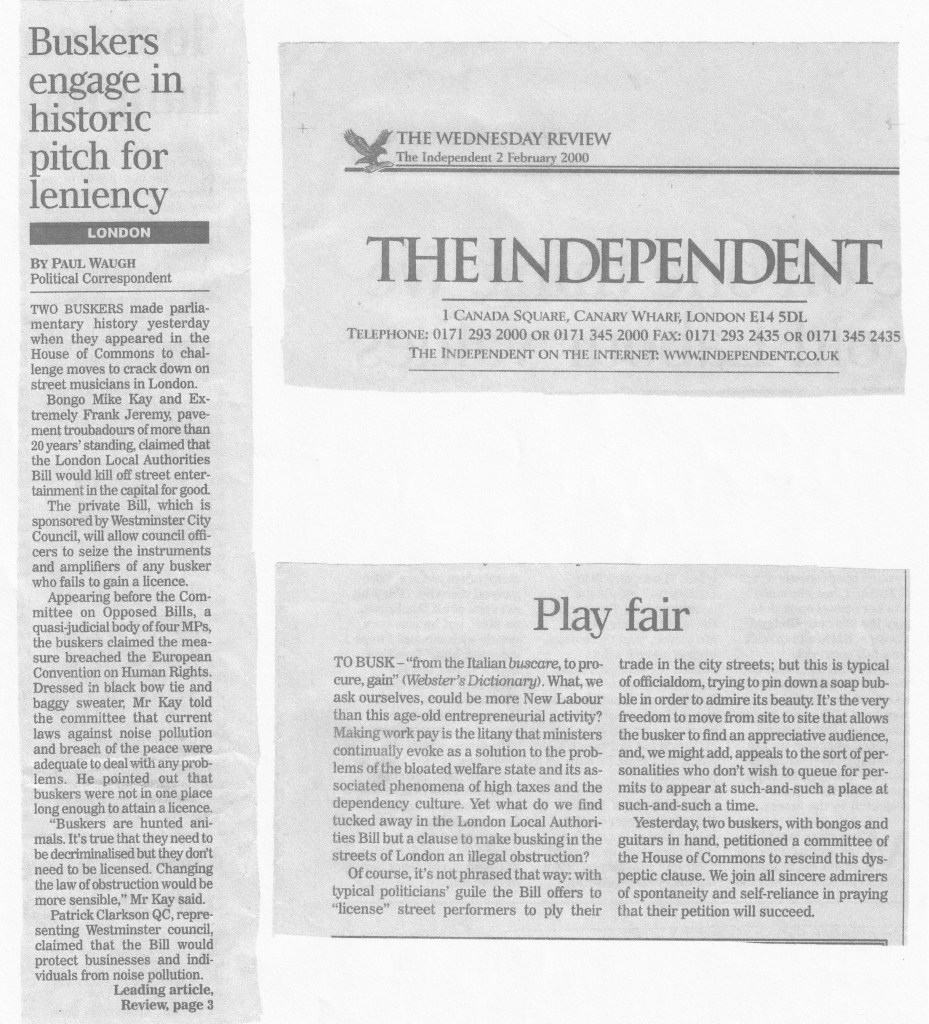
And I want to mention here thewidespread opposition, amongst buskers that I have known, to the idea of a licensing scheme as the way forward, be it on the street or on transport systems. I shall in a future post give a full run-down of the legal story as I understand it, but for now I just want to display a few articles from two issues of the Independent in 2000, covering an appearance by Bongo Mike and myself before a parliamentary Opposed Bill Committee discussing proposals for the regulation of street entertainment. The press, if not the MP’s, got what we were saying. (The article entitled Private View is couched in a style of humour fashionable in its day, which I’m personally not too fond of, but the final paragraph makes some crucial points that are not often expressed.)
“Well that’s all very well”, I hear your inner bureaucrat objecting,“but how then is the whole thing ever to be regulated to everybody‘s satisfaction?”
Let me give full disclosure here – Bongo Mike and I did once obtain a licence, in 1997, to perform on the trains of the ‘S’ Bahn system in Nordrhein Westphalen, Germany, but only as a novelty for a brief period of two weeks, and the experiment – although quite successful – was not repeated. And as I have said, such performances remain illegal on all of Britain’s train systems.
A variation in the legislation regarding street music in London and elsewhere in UK has meant that busking in the street is no longer treated as a matter for the police in the first instance – except, presumably, in extreme situations which might arise in any case. It is now a matter between the performer and the local authorities, who react in different ways, along the tolerant/intolerant spectrum. So far, so quite a bit better, and a vindication I like to think, as far as it goes, of the stand taken by Bongo Mike and myself on the whole issue – controversial though it was at the time. But uncertainties and injustices remain. Busking – to use again this word I don’t really like – is a culture in its own right, and attempts that are made to bring it out of the twilight where it has lingered for so long usually seem to go wrong. It is so much a thing of the moment, and that’s a very difficult quality to capture in any broader structure….
….and it is on this note, dear reader, that I must sadly take my leave of you – for now – pausing merely to remind you of my oft-repeated mantra, that answers concerning the right treatment of street musicians, buskers etc. will be hard to come by until Situation Art is inducted, in one guise or another, into the pantheon of intellectual respectability, and it is accepted that there is an aesthetic proper to spontaneous public place performance alone.









 The Story Of Situation Art